After graduation

Arts, Culture and Society
Arts, Culture & Society student

Opportunities after graduating

The master programme Arts, Culture and Society prepares you for management, policy or communication positions within government, businesses and cultural institutions. 

Academic career

Do you want to stay in academics after your graduation? Then this specialisation will also help you build strong analytical skills, enabling you to conduct independent research. This provides excellent preparation for a PhD trajectory. After successful completion of the master in Arts, Culture and Society you may be eligible for an abridged programme of the Research Master Sociology of Culture, Media and the Arts. Selection is based on your academic motivation and talent.

Alumni

Our alumni are well-represented across a broad spectrum of industries. The top 3 sectors where recent Arts, Culture and Society graduates work include:

  1. Higher Education: for example as research assistant, PhD candidate or (junior) lecturer at various universities in the Netherlands and Europe.
  2. Cultural sector: for example as exhibition coordinator, programme maker, project manager, producer or advisor at cultural institutions and the performing arts (theatre, cinema, museum, festival, publisher etc).
  3. Government: for example as arts programmer, content specialist, policy maker/advisor, or public affairs officer at a municipality or ministry.

We also see graduates starting their career in the music and entertainment industry, or in the non-profit sector. 

Organisations where recent alumni work: 

  • Museum Boijmans Van Beuningen
  • Rituals
  • WILDe Theatre / Luxor Theatre / Theatre Utrecht
  • Ministry of Education, Culture and Science
  • Rotterdam Festivals
  • Universidad de Alcalá
  • Dutch Design Foundation
  • World Press Photo Foundation
  • DutchCulture
  • Rademakers Gallery
  • Cultural Relations Platform
  • Netherlands Enterprise Agency
  • Dutch National Opera & Ballet
  • International Film Festival Rotterdam (IFFR)

Would you like to know more about the different career opportunities after your studies? On our alumni website you can read the experiences of Arts & Culture graduates. 

Testimonials

Simone Ruygrok

Alumna Bachelor Arts & Culture Studies + Master Arts, Culture & Society

The broad approach to the cultural sector in the bachelor programme really appealed to me
Portrait photo of alumna Simone Ruygrok
The broad approach to the cultural sector in the bachelor programme really appealed to me

Study programme: Bachelor Arts and Culture Studies and Master Arts, Culture & Society
Graduation year: 2021 & 2023
Current job: Project Manager Hall of Fame on Tour (freelance) at Nederlands Fotomuseum

Broad approach to the cultural sector

When I had to choose a degree programme, I knew right away that I wanted to study something related to arts and culture. I visited several universities offering programmes in this field, but ultimately chose the Bachelor Arts & Culture Studies at Erasmus University Rotterdam (EUR). The broad approach to the cultural sector in this programme appealed to me the most. The programme examines art and culture from multiple perspectives, including sociological, media, and economic viewpoints. This provides a complete picture of the cultural sector, which I found incredibly interesting. 

Gaining practical experience

A highlight of the bachelor programme for me was my internship at the Netherlands Photomuseum (Nederlands Fotomuseum) and my exchange to Aarhus (Denmark). During my internship, I got to see what it is like to work in a museum and, in addition to all the theoretical knowledge, I gained a lot of practical experience. It was also a very special experience to live and study in a completely different country and city for one semester. During this time, I made new friends with whom I am still in contact.  

Increasing opportunities on the job market

During my master's programme in Arts, Culture & Society, I already started thinking about how I could increase my chances on the job market in the cultural sector. I took a part-time job at Cinerama, Rotterdam's oldest movie theatre, and did an internship at the Council for Culture in The Hague. This allowed me to gain work experience not only in the cultural sector but also in cultural policy, helping me to further build my professional network. Additionally, I collaborated with two cultural institutions while working on my master's thesis.

After graduating, I was able to start working full-time as a floor manager at Cinerama. I also applied for many jobs, and kept in touch with my internship organisations. Ultimately, building a network and gaining experience is very important if you want to work in the cultural sector. Thanks to the network I had built up during my studies, I eventually landed my first real assignments: both the Nederlands Fotomuseum and the Raad voor Cultuur  asked me back for a project six months after graduation. I became a freelancer and my career in the cultural sector really took off, allowing me to work on some really fun and interesting projects as a recent graduate. 

I am currently the project manager for a project at the Nederlands Fotomuseum. This involves many different tasks, but my main responsibility is to ensure that all the practical aspects of the project are taken care of and run smoothly. This includes communication and coordination with suppliers, design agencies, and photographers, as well as monitoring the planning and progress of projects, and overseeing finances.

Added value academic knowledge

The broad Arts & Culture studies at EUR have taught me a great deal of knowledge and skills that I now apply in my position as project manager. For example, in the community project I am currently working on, we think a lot about making art more accessible. My knowledge of cultural sociology is extremely useful in this regard. What is really good and unique about the Bachelor Arts & Culture Studies is that the curriculum also includes courses in economics and management, which has given me a lot of knowledge about budgeting and planning. This is now helping me in arranging the practical aspects of a project.

Advice for arts and culture students 

Gain as much (practical) experience as possible and build a social network. For example, become a volunteer at a festival or organisation that you really like, or find a part-time job that is somewhat related to the direction you want to work in. Many cultural organisations need volunteers; this is an easy way to get a glimpse into a cultural institution and meet other people in the sector!

Plus, an internship is very helpful in gaining valuable work experience: this is a mandatory component of the bachelor's programme. It is an opportunity to develop yourself professionally and build your network with relevant people from the sector. This network is important for getting started in the cultural sector, especially if you want to work as a freelancer. Your network will help you find new assignments in the sector.
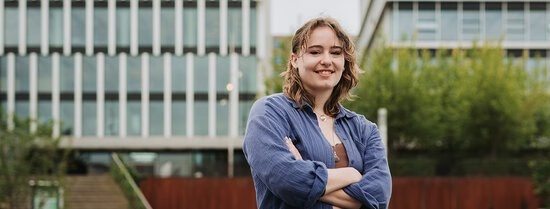


Portrait photo of alumna Simone Ruygrok

Beatriz Merino

Alumna Master Cultural Economics and Entrepreneurship

Use your studies not just to absorb knowledge, but to experiment, collaborate, and find your own voice within the cultural field
Profile picture of ESHCC alumna Beatriz Merino to support written testimonial
Use your studies not just to absorb knowledge, but to experiment, collaborate, and find your own voice within the cultural field

Beatriz Merino graduated from the Master Cultural Economics and Entrepreneurship at the Erasmus School of History, Culture and Communication (ESHCC) in 2020. She works in a creative, international environment as Senior Marketing Coordinator at Berklee College of Music. In a short interview, we asked her to reflect on the master programme and how it has helped her shape her professional path to this day. In Beatriz’ words: “Use your studies not just to absorb knowledge, but to experiment, collaborate, and find your own voice within the cultural field.”

What makes the Cultural Economics and Entrepreneurship (CEE) master programme unique in your opinion?

I was looking for an international master’s programme that could bridge my previous education in business with my passion for culture, especially music, music performance, and the performing arts. The Cultural Economics and Entrepreneurship master at Erasmus University Rotterdam offered exactly that blend. Both the academic quality, as well as the reputation of the programme and its scholars is what attracted me most about studying this master. 

The courses and electives encouraged me to explore topics I was interested in, while also exposing me to a wide range of perspectives from classmates passionate about other areas like visual arts, cultural policy, cinema, sustainability, fashion, architecture, and more. What I valued the most was the freedom to develop my own interests. Through research, I created my own ideas, thought critically about the cultural sector, and understood how economics, creativity, and entrepreneurship intersect. That mindset has stayed with me throughout my career.

Can you tell us a bit more about your career?

Currently, I work as a Senior Marketing Coordinator at Berklee Valencia, the international campus of the prestigious Berklee College of Music. My work involves developing and executing digital marketing campaigns, conducting market research, and defining and coordinating content to increase audience awareness and engagement. What I enjoy most is the challenge of communicating the value of a world-class music education through both creativity and data-informed strategies.

What skills that you learned during the Cultural Economics and Entrepreneurship master turn out to be of most value in your current position? 

The master’s degree strengthened my research and analytical thinking. It taught me, for instance, to understand how cultural and creative industries evolve and how audiences engage with them. This knowledge helps me today to connect broader cultural and music industry trends with what we offer at Berklee Valencia, making our communication and marketing more relevant and meaningful.

How did you get this job? 

After graduation, I explored multiple opportunities across Europe. When I discovered the position at Berklee Valencia - a creative, international environment which is also closer to home - it immediately felt like the perfect match. I feel very fortunate to have joined the team. I believe that my unique combination of skills and perspectives developed during the CEE programme helped me stand out among other applicants.

Which elements and/or (extracurricular) activities of the study programme have helped you prepare yourself for your career?

Besides my thesis, I particularly valued the courses ‘Cultural Organizations’ and ‘Applied Cultural Entrepreneurship’. In Cultural Organizations, we worked on case studies that developed our strategic thinking and problem-solving skills. Applied Cultural Entrepreneurship allowed us to work to launch our own artistic productions. We also worked on consultancy projects with real companies and institutions from the cultural sector, acting as junior agents in roles like programmers, managers, marketers, and fundraisers. 

Studying at Erasmus University also offers access to student clubs and associations, where you can learn while meeting like-minded people. In my case, I joined the Stukafest festival as PR and Marketing Coordinator, collaborating with fellow master students and other cultural enthusiasts from the Rotterdam community.

What would be your advice for arts and culture students or future graduates?

Stay curious and open-minded. Learn not only from the theory and classes, but also from your peers, their perspectives, interests, and experiences. Rotterdam has a lot to offer: a vibrant cultural scene, museums, performances... And while studying, stay true to your passions and explore them through research. Use your studies not just to absorb knowledge, but to experiment, collaborate, and find your own voice within the cultural field.

Profile picture of ESHCC alumna Beatriz Merino to support written testimonial

Liza Oostenbrink

Alumna Master Cultural Economics and Entrepreneurship

I chose to study the master specialisation Cultural Economics and Entrepreneurship beacause I could learn more about the various disciplines within the arts and culture sector.
Liza Oostenbrink
I chose to study the master specialisation Cultural Economics and Entrepreneurship beacause I could learn more about the various disciplines within the arts and culture sector.

Getting to know various disciplines

Getting a job in the arts and culture sector can be quite challenging. There are many great positions, but the competition is high. This makes it a challenging sector to start working in after your studies. I therefore decided to first expand and specialise my knowledge in the field of arts and culture after obtaining my bachelor degree in Arts & Culture.

I chose to study the master specialisation Cultural Economics and Entrepreneurship at the Erasmus School of History, Culture and Communication, as it connected well with my bachelor's degree, and I could learn more about the various disciplines within the arts and culture sector. There was a wide range of electives, which made it not only possible to study the subjects that I was interested in, but also to look at the field from different perspectives.

Landing a job in the heritage field

During my bachelor and master, I always had an interest in heritage and followed electives that addressed this topic. When I finally started writing my master thesis, I chose to write about the reallocation of cultural heritage in the Netherlands. I had several conversations with heritage organisations. During one of those talks, I was offered a job, which made it possible for me to start working in the heritage field right after completing my studies.

After three years working as a property manager at a commercial heritage organisation, it was time to move to a position where I would be more substantively involved with heritage. And so it happened: since April 2024, I am working as a policy officer for the Municipality of Nissewaard.

Why I love my job! 

As policy advisor for monuments and heritage at the municipality, I deal with various tasks. Just a few examples; I am secretary of the Heritage Committee, I process and advise on applications for the subsidy for municipal monuments, and I think along about the future of church buildings within our municipality.

Working for a municipality also means that I get to work with different parties. One moment I am talking to the aldermen, and the next I am on-site talking to monument owners. This diversity in my work and environment, as well as being able to contribute to the preservation of heritage makes me really enjoy my job!

The master programme Cultural Economics and Entrepreneurship taught me to be critical, but also to look at the bigger picture and think beyond what is in front of me. This is really helpful in my current position at the municipality. 

Liza Oostenbrink

Luka de Ruijter

Alumna International Bachelor Arts & Culture

I put the academic theory I learned during my studies into practice at IFFR, when writing funding applications
Profile picture IBACS alumna Luka de Ruijter
I put the academic theory I learned during my studies into practice at IFFR, when writing funding applications

Choosing an Arts & Culture study programme

After high school and a subsequent gap year, I did not have a specific career path in mind. The only thing I knew is that I wanted to be involved in the cultural sector, as in my spare time I regularly went to the cinema, museums, concerts, and I enjoyed nightlife. I ended up studying the International Bachelor Arts & Culture Studies (IBACS) at Erasmus University Rotterdam (EUR). Why I chose this study programme? That’s what you will read below!

The main reason for me to study IBACS was the broad approach of this bachelor programme, which is unique in the Netherlands. It allows you to study culture from different theoretical perspectives, from sociology to economics. In addition, studying on campus in an international environment really appealed to me. I thought learning in a classroom with students from all over the world, who all bring their own stories to the table, is extremely valuable - especially in the context of arts and culture. In retrospect, this certainly turns out to be true. The possibility to go on exchange was another important factor for me to choose IBACS. During my studies, I gladly made use of this opportunity by studying in Tokyo for six months.

Last but not least, I found the fact that this international programme is taught in Rotterdam a big plus. It is a super-diverse city home to many creative and talented people. The cultural and creative industries are vibrant and resilient, ranging from interesting established cultural institutions and world-renowned architecture firms to impactful grassroots initiatives. 

Job hunt

After completing my master programme Cultural Economics and Entrepreneurship at EUR, I was ready to enter the labour market. I started looking for vacancies and applied to various cultural and government organisations in the Netherlands. In my search, I visited several places, such as museums, to discover whether I could envision myself working there. Besides that, I told my network – friends, family and acquaintances – that I was looking for a job. 

At some point the vacancy of Assistant to the Board of Directors at International Film Festival Rotterdam (IFFR) caught my attention. The position matched my interest in the film industry, as well as my work experience, as I had previously completed an internship at a film production and distribution company. Since I was not exactly sure what specific direction would suit me when job hunting, I thought it would be a perfect starting position to get to know the insights of an organisation and develop myself professionally. Now I am working as Coordinator Funding and Private Partners at International Film Festival Rotterdam.  

Theory put into practice at IFFR

Together with three colleagues, I work in the Funding and Business Growth department at International Film Festival Rotterdam. I find it very valuable to work in a small team, as we exchange ideas and learn from each other's expertise and jointly contribute to improving the financial position of the organisation. The focus in my role is mainly on identifying funding opportunities, writing funding applications and relationship management. My role requires staying up-to-date on the (inter)national cultural funding landscape, creating and executing communication plans, and doing research.

My studies at the Erasmus School of History, Culture and Communication have backed me up with knowledge on the value of culture from different academic perspectives and deepened my understanding of the developments and mechanisms driving the cultural and creative industries. I literally put the academic theory I learned during my studies into daily practice when writing and brainstorming. The various group assignments during my studies have contributed to my ability to collaborate on projects at work. Different concepts covered during the courses, for example social impact and cultural participation, are important when thinking about organising and financing our activities. Here, the analytical and critical thinking skills I learned at the university, come in handy. 

Golden tip(s)

My first tip is to gain experience and practical skills outside your studies, by volunteering, working and/or joining an association. Most cultural events in Rotterdam simply cannot exist without their volunteers. The film festival, for example, would not take place without its 600 volunteers, many of which are – international – students. Through volunteering you get a behind the scenes experience and connect with fellow Rotterdam residents over a shared passion.

Secondly, the mandatory internship in IBACS is a great opportunity to find out where your qualities lie and to gain confidence in the professional field. This period helps to reflect and ask yourself questions to figure out in what field you want to enter the labour market. The internship also allows you to think about the kind of working environment that makes you thrive: a small or large organisation, hierarchical or more horizontal, and so on. 

Finally, and perhaps the most important tip: explore and enjoy all that the city of Rotterdam has to offer. The Rotterdam mentality is contagious. Try to look around and see what is happening in the city. Visit places that give you energy and inspiration. You never know who you will meet and what it can bring you. 

Profile picture IBACS alumna Luka de Ruijter

Compare @count study programme

  • @title

    • Duration: @duration
Compare study programmes