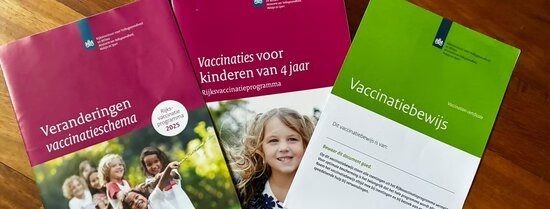
Why do some highly educated parents choose not to vaccinate their children, or not to vaccinate them fully? Sociologist Josje ten Kate (Erasmus School of Social and Behavioural Sciences) explored this question in her doctoral thesis, interviewing numerous parents. Her research shows that scepticism among this group rarely stems from distrust of science, but rather from a strong sense of responsibility and their own way of seeking the truth.
Ten Kate became interested when she noticed that vaccine scepticism was not only prevalent among groups that often attract the attention of policymakers, such as those with practical training. "There were anecdotal signs that parents with theoretical training sometimes had doubts about vaccination. This contradicted much of the existing research. That curiosity prompted me to investigate: what is actually going on here?‘ She spoke to numerous parents for her research. This sometimes yielded surprising experiences. ’I did notice some reluctance beforehand. People wondered what my intentions were. But the conversations I ultimately had were actually always very friendly and open. People were eager to share their stories."
Those conversations often turned out to be emotional. Doubts about vaccinations were often linked to personal experiences, such as medical complications and fear of possible side effects. One parent, for example, recounted how her child had a severe allergic reaction after a jab, which had deeply shaken her confidence. Vaccination scepticism often led to stigmatisation. Some parents said that their children were bullied at school because their parents had a different approach to vaccinations and were called "wappies".
Two perspectives on doubt
In the interviews, Ten Kate identified two distinct perspectives. The first is nature-oriented. Parents in this group rely heavily on intuition and view health as something natural. 'They say, for example, "I feel that vaccination is not good", or "I follow my gut feeling." They distinguish between what they see as natural and unnatural. Vaccinations often fall into the latter category.'
'I want to strengthen the immune system naturally (...) with as little pharmaceutical influence as possible'
Quote from a parent
This does not automatically mean that they reject vaccinations entirely. Some parents consciously choose certain vaccinations and not others, for example because they see some diseases, such as measles, as part of a child's "natural development". The second perspective is strongly science-oriented. These parents actively seek out studies, consult doctors in their network and try to gather evidence. 'They emphasised: I trust science and want to know whether information comes from reliable sources. They actually took on the role of the researcher themselves.'
This sometimes leads to doubt, precisely because science rarely offers absolute certainty. 'They want to be one hundred per cent sure that their child will not suffer any side effects from a vaccination. But that can almost never be guaranteed. That's where the problem lies.' According to the researcher, both perspectives stem from an "individualistic epistemology": parents see it as their responsibility to determine for themselves what is true. Advice from doctors or authorities is taken into consideration, but not necessarily followed.

'Aren't you secretly working for the RIVM?'
Many parents seek information within their own network or online communities. Ten Kate found some of her respondents through a private Facebook group run by a critical vaccination organisation (Kritisch Prikken). ‘There were parents there who were very relevant to this study. But you also immediately notice that there are questions: aren't you secretly working for the RIVM? What is your intention?’
Ten Kate also investigated how information campaigns work. The results were striking. "In survey experiments, I found no positive effect of providing extensive information on support for vaccinations. Sometimes it had no effect or even a negative effect among some groups." Mass campaigns often do not match the way parents themselves think. For one group, scientific information is important, while another group is put off by terms such as “laboratory research”. This makes it difficult to reach a broad audience with general campaigns.
Timing and personal contact
Timing also appears to be crucial. Doubts often arise early on, when parents first start looking into vaccinations. 'Once people have formed an opinion, it is difficult to change it.' Nevertheless, the PhD candidate does see some points of departure. Personal contact makes a difference. Parents who feel listened to by a doctor or paediatric nurse indicated that they were more willing to vaccinate, sometimes in a modified form, deciding to vaccinate their children against certain diseases after all. 'Interaction with healthcare providers was very important to parents. If there was room for questions and customisation, that helped.'
'There was an employee there who wasn't so rigid (...) so we ended up following a different schedule'
Quote from a parent
Broader than vaccinations
According to Ten Kate, the findings reveal something that goes beyond vaccinations alone. Doubt does not necessarily arise from a lack of knowledge, but from a way of thinking in which people take responsibility for their own choices and actively weigh up information. 'You see that parents are strongly encouraged to take control and judge for themselves what is good for their child. It has become quite normal to look up information, compare it and not just accept everything at face value. This also explains why some choices, which may seem strange to outsiders, make perfect sense to parents themselves.'
- PhD student
- More information
More science stories? Have a look at our online magazine Erasmus Extra.
Press
For more information, please contact Marit Haven of Erasmus School of History, Culture and Communication via email.- Related content
- Related links
- PhD defense Josje ten Kate


