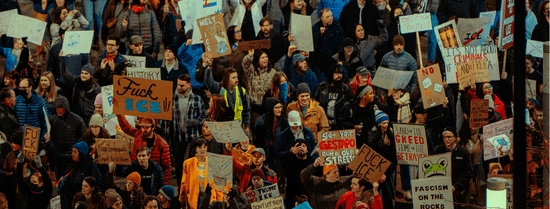
Artists are increasingly faced with the dilemma of whether to make themselves heard in times of social unrest. The pressure to do this from fans is growing. During the Grammy Awards ceremony in February, several major musicians, including Billie Eilish and Olivia Dean, made statements against ICE during their speeches. But what is the impact of such a statement? And why do some artists prefer to remain silent?
Kristina Kolbe is Assistent Professor in Sociology of Arts and Culture at Erasmus School of History, Culture and Communication (ESHCC). According to her, art is inherently political. 'Art (and thus music) is often not an individual product, but a collective production. Musicians, music institutions and commercial organisations all shape the product, especially with bigger artists.' There are many ways that artists can partake in cultural activism, if they decide to do so. 'Some artists are very explicit, like pop artist Billie Eilish at the Grammy’s saying “Fuck ICE” and Irish band like Kneecap openly supporting Palestine', Kolbe states. ‘Those artists also often use their (social media) platforms to express their political standpoints.'
But there is also quiet activism, a form of activism people may not immediately recognise as political. This kind of activism focuses more on community building. 'It’s about supporting and including marginalised groups, creating safe spaces and working on collaboration', Kolbe explains.

The consequences of a political statement for musicians
The implications of making a political statement can vary from artist to artist. 'Migrants, people on temporary visas, and other marginalised groups such as musicians with a working-class background face a greater risk of serious consequences for speaking out, such as losing funding or being censored’, Kolbe explains. ‘They often don’t have the safety net that larger artists do', she explains.
Even though the risk for these groups is higher, artists from marginalised communities often speak out more. 'Their lived experience of inequality strengthens the connection between art and politics. You see this with artists who have a marginalised background, like UK rapper Stormzy and Latin artist Bad Bunny.'
'Authoritarian politicians feel threatened'
The performance of Bad Bunny at the Superbowl Halftime Show was heavily critised by right-wing politicians in the US. In a message on his own social media platform, president Trump wrote about Bad Bunny’s halftime show: “absolutely terrible, one of the worst, EVER!”. During the show, the Puerto Rican artist celebrated Latino heritage and culture and focused heavily on solidarity, community and love being stronger than hate. The show is now the most-watched halftime show in history. 'Authoritarian politics feel threatened by art and culture because it can build community, promote diversity and multiculturalism, create solidarity and enable collective identity', Kolbe says about Trumps words. 'In times where politicians polarise people, music connects. Bad Bunny’s performance shows this. Another example are the pins with anti-far-right slogans like “ICE out”, that various artists wore during the Grammy’s. This is a more targeted and direct message, but one is not necessarily more effective than the other.'
The message "The only thing more powerful than hate is love" was shown at the end of Bad Bunny's Superbowl halftime show on February 8, 2026 (see photo below).

Creating the perfect image
Once musicians start working with commercial organisations like record labels and managements, they often start to prioritise branding, profit and their public image. In 2024, mega pop star Taylor Swift encouraged people to vote for the presidential elections on her Instagram account, resulting in over 700,000 people signing up to vote. 'Swift and her team have very successfully created a public image of this All-American girl, which might be the reason why she tends to play it safe and has never really spoken out politically', Kolbe says. 'This gives her power in reaching various domains in demographics in the US, which her fanbase represents. But Taylor Swift is so elite, she is literally a billionaire with a massive safety net. In my opinion, artists don’t always have to be outright political. But I think there is a moment in time where artists should be.'
About Kristina Kolbe
Kristina Kolbe joined ESHCC after completing her PhD in Sociology at the London School of Economics and Political Science and working as a postdoctoral researcher in Sociology at the University of Amsterdam. Her work explores how intersectional inequalities or ‘race’, class and gender are reworked in and through culture. Her particular interests lie in the field of music and its relationship to urban multiculture, and in the contingent social effects of on-going diversity and inclusion discourses in the cultural industries, as well as in the relationship between cultural production, care politics and creative activism.
- More information
More science stories? Have a look at our online magazine Erasmus Extra.
Press
For more information, please contact Marit Haven of Erasmus School of History, Culture and Communication via email.- Related content


