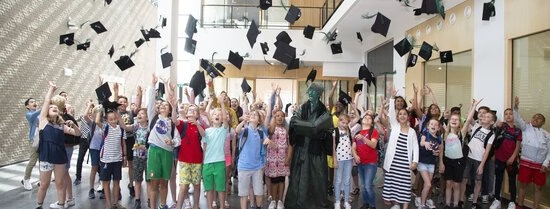
As with many parents of gifted children, the search for suitable education for Yara (7) was not straightforward. Giftedness does not have a fixed profile. One child may struggle, another may not stand out, and sometimes both may be the case. How do you ensure education that is truly suitable?
For the family of Pim Tempelaars from Gouda, that search was anything but easy. All four of their children turned out to be gifted. It took a long time for their eldest daughter to be recognised as such. She struggled at two primary schools and battled with mental health issues. 'She is a sensitive, quick-thinking girl who does not necessarily fit the stereotype of "giftedness",’ says Pim. When their second child also turned out to be gifted, they began to realise that there was more going on within the family.
Yara is their third child. She was also diagnosed as gifted. What's more, her parents later discovered that they themselves are gifted too. Pim: 'We didn't know that beforehand. It was only when my eldest daughter really got stuck at school and I got stuck at work that giftedness became something we actually wanted to eliminate, but in the end that's what it turned out to be.'

Struggle and customisation
The search for suitable education was intense. 'Our children are all very different, which can make it challenging at times,' says Pim. 'The spectrum of giftedness is very broad. It's also a very difficult group to cater to.' What does he believe is essential? 'This group thrives on complexity and speed.'
Good integration into mainstream education is not a given. 'It's really boring for those children,' he says honestly. A folder with extra assignments is not always enough. That is precisely why they looked for enrichment outside their own school. Through an online search by his wife, they ended up at the Erasmus Junior College of Erasmus University Rotterdam.
Learning to think like a researcher
The Erasmus Junior College is intended for gifted and highly gifted pupils in grades 6, 7 and 8 of primary school. After an inspiring opening lecture, they work towards their own research project in seven lessons. This can be done in an enrichment class at school or together with pupils from other schools on the university campus.
Under the guidance of specially trained student teachers, the children go through the research cycle step by step. They learn to ask questions, argue, analyse and present. Topics range from philosophy and law to medicine, economics and sustainability.

Bright spot in the week
Seven-year-old Yara is now taking her third series of lessons. She previously chose The Future and Law, and now she has chosen Philosophy. What does she like so much about it? Yara: 'That you can choose which subject you want to study and that it is often challenging. The assignments are very different from those at school.'
She recently worked on a thought experiment. What is that? 'A little study you do in your head.' Is it difficult sometimes? 'Yes, it is. Sometimes I don't quite understand it. That can be annoying. But I often figure it out myself.'
For father Pim, the added value of the lessons is clear. 'It's a highlight. A bright spot in the week,' he says. He notices this at home with Yara. 'She always comes home feeling great. Sometimes with stories, sometimes with new ideas. It's not as if it's black and white, from zero to wow. But it's a very good extra breeding ground. A nice extra layer in her life.'

To be seen
Student teacher Nina, who teaches Philosophy, observes the impact this has on children. 'This series of lessons focuses primarily on research skills. One of the sessions centred on the theme of opposites, using good and evil as examples. The pupils discussed a story and then explored the well-known trolley problem: would you save five people or one? It sparked a meaningful conversation.'
Afterwards, the children worked in groups on their own thought experiments. The responses she received touched on the very essence of the programme. 'There were two or three pupils who said: it was fun, it was challenging, it was difficult, and that's not something I'm used to.' According to Nina, this shows that these children feel seen. 'Perhaps they are in a class where that happens less often.'
Parents also notice the difference. 'I had a parent who told me that her child wanted to continue reading a book with a philosophical slant at home,' says Nina. 'That shows me that they are really engaged with it.'
Dare to give them difficult assignments
What advice does Pim have for other parents? 'Don't fall into stereotypes. Every gifted child works differently. Make sure you tailor your approach to each individual.' And don't be afraid to talk to the school. 'Don't be afraid to stand up for your child.' He believes it is essential that children are challenged at their own level. 'Trust them. Don't be afraid to give them difficult assignments sometimes. They are capable of much more than you think.'
For Yara, that means thinking about right and wrong, meeting new children and sometimes getting stuck, only to find her own way out again. Not because she has to, but because she wants to understand how things really are.
- More information
The Erasmus Junior College is organised by the EUR Wetenschapsknooppunt. Het Wetenschapsknooppunt (The Science Hub) brings science to primary and secondary school classrooms. By offering various educational programmes and activities, we ensure that children are exposed to science, research and university from an early age. In this way, we make the path to higher education more transparent and accessible, especially for children for whom studying is not a given.
Would you like to know more about the programme offered by Wetenschapsknooppunt? Please contact us at wetenschapsknooppunt@eur.nl or visit our website.
- Related content

