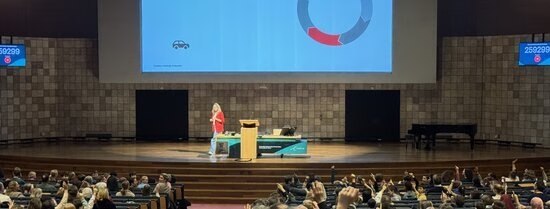
Imagine you have a child who thinks just a little faster than average. Who needs more than just the standard textbook. How do you ensure that their talent is not only recognised, but also nurtured? That's where Erasmus Junior College comes in. A series of lessons for gifted and highly gifted children in in the upper years of primary school. 'It is extremely valuable for them to be introduced to science at such an early age,' says scientist Prof. Dimitri van der Linden, who himself has a gifted son.
Dimitri van der Linden conducts research into the interplay between individual character traits and (high) intelligence. An IQ of 130 or higher is generally considered to indicate giftedness. Approximately 2.3 per cent of the Dutch population is gifted. That amounts to around 423,000 gifted adults and 37,000 gifted children in primary education. Dimitri's son is one of them.
Class with extra challenges
The search for suitable education for his son proved complicated. 'When you read the websites of primary schools, it seems as if every school pays special attention to gifted children. But in practice, that's not always the case.' Eventually, Dimitri and his wife found a school with a structured programme: a separate class for pupils who need extra challenges. 'Then you notice the difference. They are given extra challenges such as Spanish and chess. And they are with children who have the same interests.'

Recognising and nurturing curiosity is central to the Erasmus Junior College. In this programme, organised by our university, gifted and talented pupils in the upper years of primary school follow a series of seven lessons. After an inspiring opening lecture, they set up their own research projects under the guidance of specially trained student teachers. Using the research cycle, they learn to formulate questions, argue, analyse and present.
Increasing the chance of a spark
The themes, ranging from Medicine and Psychology to Sustainability, Law and Checkmate, offer an introduction to various scientific fields of thought. According to Dimitri, this is extremely valuable. 'You have to encounter something before it sticks,' he says. 'Some things just slip away. But sometimes you see something and think: hey, this is interesting. Then something can develop.'
He compares it to sport. 'You can enrol a child in football, but they may not stick with it. Then you try something else. At some point, something comes along that gets the child really enthusiastic. It's the same with science.' He believes that a programme such as the Erasmus Junior College increases the chance of that spark. 'You are confronted with it. You see what a researcher does, what is possible. That can give direction.'
IQ tests are more than just a snapshot
Research into intelligence has been conducted for over a century. Yet the subject remains shrouded in misunderstanding, explains Van der Linden. 'People often say that an IQ test is only a snapshot in time. But if you follow large groups over a longer period, you see that those scores do correlate with later outcomes.' He refers to long-term studies in which children with very high scores were followed for decades. 'A striking number of them later became successful scientists, writers and prize winners. That is no coincidence.'

At the same time, he emphasises that high intelligence is no guarantee of a carefree school career. 'Most gifted children get through the material just fine,' he says. 'But sometimes you see them getting stuck. Often this is due to a combination of factors, such as giftedness combined with ADHD or autism.'
This combination can make talent less visible or lead to it being misinterpreted. 'There is a perception that gifted children are always socially awkward or "nerdy", but that turns out not to be the case at all,' says Dimitri. 'Large-scale studies show that most of them are actually very well adjusted.'
The right guidance
Dimitri sometimes recognises what he sees in his research at home. 'At first, school was a real problem,' he says. 'He was very stubborn. If he didn't find something interesting, he simply wouldn't do it.' Perfectionism also played a role. 'He wanted to do very well. If something went wrong, he would quickly give up. You see that a lot: they're not used to reaching their limits.'
A programme such as Erasmus Junior College can offer the right guidance in this regard. The methodology of inquiry-based learning runs like a thread through Erasmus Junior College. This way of learning is ideally suited to gifted children. During lessons, they are given a great deal of autonomy, have a say in their own learning process and work on executive skills.
'When children are exposed to science, new ideas and different ways of thinking, something can click. And when that happens, it can shape the rest of their lives,' Dimitri concludes.
- Professor
- More information
The Erasmus Junior College is organised by the EUR Wetenschapsknooppunt. Het Wetenschapsknooppunt (The Science Hub) brings science to primary and secondary school classrooms. By offering various educational programmes and activities, we ensure that children are exposed to science, research and university from an early age. In this way, we make the path to higher education more transparent and accessible, especially for children for whom studying is not a given.
Would you like to know more about the programme offered by Wetenschapsknooppunt? Please contact us at wetenschapsknooppunt@eur.nl or visit our website.
Press enquiries?
Dimitri van der Linden works at the Psychology programme of Erasmus School of Social and Behavioural Sciences (ESSB). For requests to Prof. Dimitri van der Linden, please contact the ESSB press officer: Marjolein Kooistra, +31 (0)6 83676038, kooistra@essb.eur.nl.
- Related content

