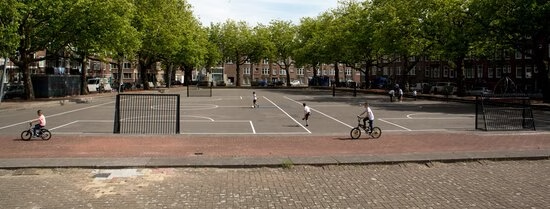
Rotterdam aims to be the best city in the Netherlands in which to grow up by 2050. What does it take to achieve this? According to Dr Joyce Weeland, a researcher in the Youth & Family department at the Erasmus School of Social and Behavioural Sciences (ESSB), the answer lies not only in playgrounds, green spaces and safe streets. The way people interact with one another and live together in a neighbourhood is just as important.
A clean neighbourhood, plenty of play areas and space to play outdoors: these are important factors in ensuring that children grow up to be healthy and resilient. This is supported by previous scientific research.
Last June, the Rotterdam coalition stated in its agreement that it intends to do "everything in its power" to give every child in Rotterdam the chance to grow up well and develop to their full potential. So, what is the situation in Rotterdam now?

Not all facilities are being put to good use
According to Weeland, Rotterdam’s status as a city varies greatly from neighbourhood to neighbourhood. In some neighbourhoods, for example, housing, shops, restaurants and cafés, healthcare and green spaces already blend together nicely. This means that residents bump into one another more often: 'When you keep bumping into your neighbours everywhere, it helps to create a sense of community.'
At the same time, unfortunately, not all facilities are being put to good use. Weeland sees this, for example, with playgrounds. In her own neighbourhood in Rotterdam-West, for instance, there are two play areas – including a new playground in the Dakpark with a cable railway – which are rarely used. 'It’s a really lovely play area, but it’s often closed at the moment. Due to a shortage of volunteers, playgrounds are regularly closed,' she explains.

According to Weeland, this is a missed opportunity. Play areas can play a central role in the neighbourhood. In other cities, for example, playgrounds are also used as venues where the Municipal Health Service (GGD) or the Centre for Youth and Family (CJG) are present. This allows parents with parenting queries to pop in easily without having to go to a specific, potentially stigmatised location: 'On paper, you might think: this is a small thing that we can easily cut back on to set up something bigger. But it is precisely in a place like this that different things come together,' explains the researcher.
Trust between residents is the foundation
It is precisely the connections between local residents that appear to be a key starting point for improvement. This is evident from the CORNER project in Rotterdam, where Joyce Weeland is the project leader. In this project, residents, children, welfare organisations, the local authority and researchers are investigating what children need to grow up resilient. In the three participating neighbourhoods – Bospolder-Tussendijken, Rubroek/Oud-Crooswijk and Reyeroord – residents and neighbourhood professionals each chose their own priority area.

In one neighbourhood, trust between residents is key. In another, parents and professionals are working towards a shared mission and a common language when it comes to children growing up: how do you talk to one another about and with children? And how do you ensure that you are all working towards the same goal? In the third neighbourhood, the focus is on children’s social networks. How do you ensure that there is always someone to fall back on, should the need arise?
The latter is not a given. Mistrust amongst residents can, for example, mean that children are given less freedom to move about the neighbourhood on their own and meet people. Weeland, for instance, hears parents say that their child does not visit other people’s homes.
The result surprised her as a scientist. 'As a scientist, I would never have chosen these priority areas myself, because I think: they’re not really specific enough and are too complex as areas for innovation. It’s very difficult to take action on them. Yet it is precisely the residents and professionals who see what is needed. They genuinely see the social aspect as the foundation of everything. They point out that if there isn’t enough trust between residents, you can try all sorts of things, but nothing will actually change.'

From a playground to a social hub
That does not mean that physical space is unimportant; on the contrary. A safe street, a pleasant square or a bench by a playground can encourage residents to meet one another. The ambition set out in Rotterdam’s coalition agreement to make more space for pedestrians and cyclists can also contribute to this, says Weeland.
After all, people who walk or cycle are more likely to bump into neighbours and other local residents. 'Being able to cycle and walk safely and comfortably is essential for meeting and seeing one another.' That is why, according to Weeland, there is no one-size-fits-all formula for the ideal child-friendly neighbourhood. What works varies from neighbourhood to neighbourhood. 'You have to go into the neighbourhood and talk to the residents. And specifically, to children, too.'
Really listen to children
Rotterdam has now signed up to UNICEF’s Child-Friendly Cities initiative. Child participation is a key part of this. According to Weeland, this presents a major opportunity for the city, but only if children are actually taken seriously.
'Children can tell straight away when people are just paying a visit for the sake of it or aren’t really interested. There’s no shortcut here. You have to invest in it.' She therefore advises the local authority and other professionals to always make it clear in advance what children have a say in, and to let them know afterwards what has been done with their ideas. Even when something isn’t possible, they should explain why.

Over the coming months, they will be taking this forward themselves as part of the CORNER project. In all three neighbourhoods, residents, children and professionals are working together on a small-scale innovation centred on the chosen priority area. Around April, the results will be presented in the neighbourhoods, followed by a joint closing event, at which, amongst other things, photographs taken earlier by the children and the new innovations will be displayed.
Because, according to Weeland, the best city in which to grow up isn’t created by the town hall alone. 'I think that we, as Rotterdammers, could do with taking ourselves a bit more seriously. We often underestimate how important our own role is.'
From saying hello to a neighbour to supporting local initiatives. Or raising the issue of an unsafe crossing with the local council. These may seem like small things. But according to Weeland, it is precisely these everyday interactions that can contribute to the social fabric of a neighbourhood.
'If every resident of Rotterdam thinks: "I play an important part in this and I can make a difference, even if it might feel small and insignificant", then I believe there is tremendous potential there for the city.'
- Associate professor
- More information
Press enquiries? Please contact Marjolein Kooistra on +31(0)6 83 67 60 38 or by email: kooistra@essb.eur.nl.
More science stories? Have a look at our online magazine Erasmus Extra.
- Related content

