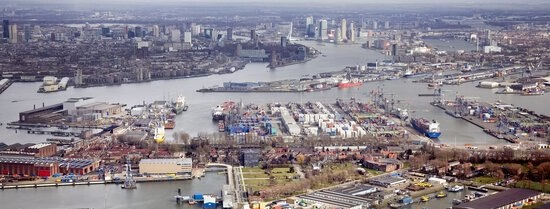
At the most recent Town Hall, Rector Magnificus Prof. Dr. Ir. Jantine Schuit announced that EUR will spend the coming years building 'Open Innovation Networks', with a focus on a resilient society and a future-proof port. How was that decision reached? How does the university create positive societal impact in this way? And what have the conversations between port, city, and university yielded so far? We put these questions to none other than the Rector Magnificus herself.
What is "open innovation" and why does it matter?
'Open innovation is the structural collaboration between science, government, business, and society. Not in project-based, ad-hoc arrangements, but in sustainable networks with a shared agenda. This is where EUR can make a meaningful societal contribution. We are exceptionally strong in the medical sciences, but also in economics, business administration, public administration, law, and social sciences. These are the disciplines you need to understand and guide the societal transitions we face. A great deal of collaboration is already happening. Take the Resilient Delta Initiative from Convergence, for example. But what we are now working on is organising knowledge more intelligently and making it more visible to the outside world.
Open innovation also means that the university must start working differently. It is no longer solely about developing and transferring knowledge. It is about collaborating from the very beginning: formulating questions together, learning together, reflecting together. Impact often emerges through interaction. That means allowing societal needs to partly shape your research questions, without losing your academic independence. It also means that contributing to societal networks, centres of expertise, and long-term collaborations must count more seriously in how we define success and how we shape careers.'

'The question is not only how the port remains competitive, but also how it contributes to broad prosperity, societal resilience, and sustainable wellbeing'
Prof. Dr. Ir. Jantine Schuit
Rector Magnificus
You are also calling for broader internal collaboration.
'The city and port of Rotterdam find themselves at a tipping point. Geopolitical shifts, economic reordering, the energy transition, and the rapid rise of digital technologies such as AI are creating considerable uncertainty about the future. The question is not only how the port remains competitive, but also how it contributes to broad prosperity, societal resilience, and sustainable wellbeing. The challenges are growing ever more complex and are deeply intertwined. Geopolitics, economics, technology, sustainability, social inequality. These are not separate dossiers. They are fundamentally interdisciplinary, and that requires an interdisciplinary approach from the university.
This also emerged from the conversations with city and port during the recent Port Symposium "Knowledge Connects Port and City". There is a strong desire for coherence — among policymakers, port businesses, and civil society organisations. People are not looking for one answer or one report, but for insight into how developments converge: what does digitalisation mean for employment, what does sustainability mean for governance, what does AI do to oversight and law?
These questions are already being researched in many places within EUR, but often still too fragmented. So an enormous amount is happening, yet it is not always visible as a collective strength. The Port Symposium showed that the energy is there, but also that we need to organise knowledge flows better.'
'The scientific knowledge we hold as a university must come together with the professional knowledge and experience of businesses'
Prof. Dr. Ir. Jantine Schuit
Rector Magnificus
Two themes are being prioritised: the future-proofing of the port and the resilience of individuals, institutions, and society as a whole. Why these two?
'The port is an obvious choice. Not only because Rotterdam is a world port, but also because so much is happening where we as a university can contribute significantly. Some people think the port is only about chemistry and technology, but it also involves legal expertise, organising an energy transition, tackling organised crime and undermining, and the health of workers. The scientific knowledge we hold as a university must come together with the professional knowledge and experience of businesses.
When we work with businesses, we also look at the knowledge development of people. Can we offer education that better prepares them for challenges in AI, the energy transition, and organised crime? A professional education offering fits within a broader movement towards lifelong learning — a development embraced by the government. In fact, this is formally becoming a public responsibility. Because we already do this kind of work privately through our subsidiaries, we can use the knowledge built there to also deliver it publicly.
The idea is also that EUR alumni remain connected to their alma mater throughout their lives. That lasting connection can strengthen ties with the port: alumni who spend their entire careers in the port can serve as a bridge between practice and science.'
What goals need to have been achieved by the next Port Symposium?
'The ambitions are great, but we are realistic. The strategy has only just begun. In two years' time, we will need to assess what has and hasn't worked. Yet the first steps have already been taken: Strategic Dean for Impact & Engagement Arwin van Buuren has, for example, taken the initiative to better connect researchers and departments within EUR. Working sessions with port businesses, the municipality, and the port authority will identify the key themes and research questions. A structure will be put in place so that questions from practice can quickly and easily reach the right experts, through a dedicated point of contact, for instance. We are looking at sustainable funding models in which external parties invest in joint knowledge development. The aim is to present concrete results at the next symposium and demonstrate that we are a reliable partner.
The Port Symposium was the starting gun. The coming years will reveal whether we live up to that promise. But with the energy felt both inside and outside the university, the foundation has been laid for a promising collaboration. The ambition is clear: from isolated projects to sustainable ecosystems. From ivory tower to open innovation. From one-way traffic to co-creation. That transformation requires patience and flexibility. We must keep finding each other — that is simply the most important thing of all.'
- More information
The Port Symposium ‘Kennis verbindt Haven en Stad’ was organised by Erasmus UPT in collaboration with Convergence and Erasmus University Rotterdam, with support from the Rotterdam Maritime Board.
- Related content

