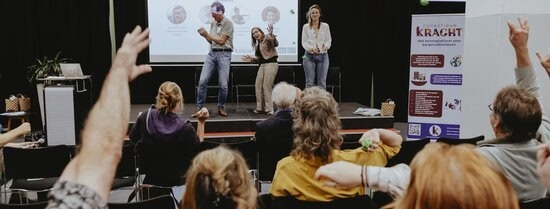
Citizen collectives are increasingly shaping how needs such as care, energy, housing and healthcare are organised in neighbourhoods across the Netherlands. How do these initiatives contribute to resilient societies? And what can the university learn from them while establishing Open Innovation Networks? CollectieveKracht is an inspirational example that hinges on something hard to measure: trust.

Erasmus University Rotterdam (EUR) is committed to fostering resilient societies, particularly through establishing Open Innovation Networks and stimulating engaged research practices. This ambition is closely reflected in the work of CollectieveKracht (CollectivePower in Dutch).
In this interview, the founder of CollectieveKracht Prof. Dr. Tine De Moor and Communications Advisor Tessa Moolenaar share how citizen collectives contribute to resilient communities. They also reflect on how the team efforts of CollectieveKracht have facilitated collaboration, knowledge exchange and stakeholder dialogue across sectors, and what others can learn from their experience in bridging research and society.

CollectieveKracht has conducted extensive research on citizen collectives. To begin, what exactly is a citizen collective, and how do they contribute to more resilient societies?
According to De Moor, a citizen collective is 'an organisation set up by citizens with the intention of providing quality goods or services (or both) for the long term and in a collective way.' These initiatives emerge when people come together around shared but qualitative basic needs, such as renewable energy, affordable housing, organic food, or humane care, and decide to organise solutions themselves for managing these resources collectively.
Citizen collectives play an important role in building resilience because they offer alternatives when existing systems do not fully meet local needs. 'Both governments and markets sometimes fail, and citizen collectives can fill that void in between and provide alternative ways of delivering goods and services,' says De Moor.
Tessa Moolenaar adds that their impact goes beyond practical solutions, as collectives strengthen communities by bringing people together around a shared purpose. 'You're building a community. People get to know their neighbours, work on something together, and feel that they have the power to make a difference.' In this way, while citizen collectives often start from practical needs, they can also lead to other positive externalities such as stronger social cohesion and civic engagement, contributing to more connected and resilient societies. 'In Rotterdam, we even see that social connectedness is the primary motivation to participate in a citizen collective.'
How did CollectieveKracht come into the picture?
The idea for CollectieveKracht emerged from a challenge De Moor observed during her research on citizen collectives. As interest in collective initiatives grew, so did the number of researchers approaching them. 'Some collectives were overloaded with surveys and research requests. I do not believe that we should not research collectives, but I think we have a responsibility to do research in a wiser and more cooperative way,' she explains.
At the same time, De Moor noticed that 'these organisations were not talking to each other, even though they tackled different problems in a similar way.' CollectieveKracht was therefore created not only to connect researchers and citizen collectives in a more responsible manner, but also to support practitioners across sectors to connect and learn from one another during meetups (in-person and online) and via the extensive knowledge base.

So CollectieveKracht brings a wide range of actors together, but how does it facilitate these connections and network in practice?
In 2025, CollectieveKracht developed the Citizen Collectives Monitor, which maps collective initiatives across the Netherlands. 'There was nothing like it before,' says De Moor. The monitor now provides an evidence-based overview that helps researchers, policymakers and collectives better understand the breadth and impact of citizen-led collective action.
Additionally, together with collectievekracht-researchers and network organisations Tine De Moor secured a prestigious grant for ECCO (Empowering Citizen Collectives in Societal Transitions). This is a large-scale, multi-year programme that investigates how citizen collectives can more effectively contribute to societal transitions and collaborate more effectively with governments. This coordination reduces overburdening on citizen collectives and will allow funding for various PhD-projects starting this September.

Today, CollectieveKracht brings together citizen collectives with representatives of governments, financial institutions, science and network organisations to facilitate knowledge exchange and constructive stakeholder dialogues through a series of dedicated partner labs.
De Moor realised universities can play a distinctive role in stimulating and organising respectful dialogue between stakeholders: 'Academics may be uniquely positioned to facilitate constructive, open dialogue in this way, as they can build on evidence-based insights while maintaining a neutral stance.' These dialogues encourage participants to move beyond their immediate challenges and identify common questions, interests and solutions.

What advice would you give to researchers who want to strengthen their engagement with society in similar ways?
According to Tessa Moolenaar, reciprocity is at the heart of CollectieveKracht's approach. The platform aims to create value for all participants through knowledge-sharing, tools, events and opportunities for exchange. 'Citizen collectives deal with limited resources, time and money. To ask them to spend time on our research and have nothing to offer in return causes friction.'
The second ingredient is trust. 'Building those relationships takes time and requires researchers to engage with communities long before asking for data or participation,' says De Moor. She stresses that trust-building is often invisible work, but essential for meaningful collaboration. Researchers should not only respond to requests from society, but actively share their knowledge, participate in relevant conversations and invest in long-term relationships.
'Building and maintaining bridges between academia and society for impact is a collective effort, of both academics and support staff, in itself'
Professor Tine De Moor
Lastly, both De Moor and Moolenaar emphasize that societal engagement requires more than researchers alone. Behind CollectieveKracht is a multidisciplinary team that combines expertise in research, communication, project management, community building and stakeholder engagement. 'This variety in people and competences is crucial to make sure that we can run the platform effectively,' says De Moor. 'Building and maintaining bridges between academia and society for impact is a collective effort, of both academics and support staff, in itself.'
Finally, as the university continues its pursuit of creating Open Innovation Networks, what do you think is essential in this process?
At the institutional level, De Moor believes universities can do more to recognise and support engaged researchers. 'First of all, acknowledge what's going on already,' she says. Universities should identify people doing this work, connect them with one another, and ensure that successful initiatives can evolve from temporary projects into sustainable infrastructure.
De Moor adds: 'For example, you cannot expect PhD candidates to build extensive networks and long-term trust relationships within the limited timeframe of a PhD project.' Instead, senior researchers should share their existing networks and connections, enabling younger researchers to build on established relationships rather than starting from scratch. But at the same time, senior scholars should also be supported to be able to build and -especially- maintain such networks.
Both Moolenaar and De Moor are convinced of the value of engaged research and the responsibility of universities to step beyond the 'ivory tower' and demonstrate the relevance of our work to society. Doing so requires trust, reciprocity, perseverance, and above all, a collective effort through a network of expertise.
- Professor
- More information
Please contact Tessa Moolenaar, Communications advisor CollectieveKracht via t.moolenaar@rsm.nl or +31 10 408 9805.
Please contact Stein Wetzer, Open Innovation Networks Facilitator for Societal Resilience via wetzer@essb.eur.nl or +31 10 754 5765.
CollectieveKracht.eu is the knowledge platform for and by citizen collectives from all sectors: from energy to housing, from healthcare to food. Want to know more? Visit the CollectieveKracht website.
- Related content


