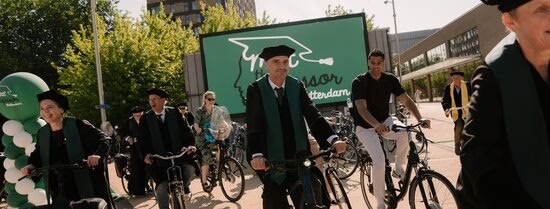
On Thursday morning, 43 professors cycled to primary schools in the region wearing their gowns to teach 1,428 children. These lessons introduce pupils to science and research in an accessible way. In this way, we show that science is accessible to everyone. 'Children are so curious. That leads to some great questions in the classroom,' says Jantine Schuit, Rector Magnificus of our university.
This is the third edition of "Meet the Professor", as the event is called. This time, 59 classes from various schools took part, ranging from schools in Rotterdam-West to Prins Alexander. Over 1,400 students in the upper years were taught about a wide range of topics: from memory to crime, and from how money works to philosophy. The professors also explained what science is all about and what a professor actually does.

Kick-off on campus
The day began at Campus Woudestein with a few school classes. Host Nizar El Manouzi spoke on stage with young Montae, who was already taking classes at the university himself, about the importance of science education: 'I felt more at ease here than at school, because I could ask lots of questions. That was great, and it will come in handy when I go on to further education, whether it be mbo a university of applied sciences or university.'
Organiser Rowan Huijgen also addressed the classes on stage and wished them lots of fun with their own lessons led by a professor later that day: 'We want to show how much fun science is. And children are the best at asking questions. We see that every year. We teach lessons on topics that aren’t usually covered in primary school. And perhaps we’ll plant a seed in the children’s minds to encourage them to come and study with us later on.'

Lesson on the brain at KC Het Oude Westen
After the opening ceremony, the professors in their academic gowns set off on their bikes and spread out across the city. Neuroradiologist Meike Vernooij went to KC Het Oude Westen primary school to give a lesson on the brain and dementia. The children bombarded her with questions: What colour is your brain? How are pills (medicines) made? And is it true that zombies like to eat brains?
'I was quite nervous beforehand. I’m not used to teaching at a primary school, of course,' says researcher Meike Vernooij. 'But the hour flew by. They had lots of pressing questions. I was struck by how much they already know about the brain, and they were also very good at making connections.'

The children are really enjoying the lesson. 'I liked the bit about what the brain looks like best,' says young Imran. One of his classmates was also enthusiastic: 'During the lesson, I really liked that we were all allowed to ask questions and that the professor answered them all.'
Just as Professor Vernooij was about to get back on her bike, a couple of girls came up to her and said, 'We’d really love it if you came back next year.'
About Meet the Professor
It is by no means a given that all children will go on to study after leaving school, or that they even know what a university is. The "Meet the Professor" event introduces primary school pupils to university in an accessible way: by bringing professors to the primary school. This helps them discover what happens at university, what science actually is, and that attending university is a possibility for them too.

- More information
The Jeugdjournaal also dropped by and filmed a report.
Meet the Professor 2026 was made possible thanks to the Erasmus Trust Fund.
- Related content

