When Julieta Bruschini first enrolled in psychology at the National University of Córdoba in Argentina, she only knew she wanted to help people. How exactly, she hadn’t figured out yet. 'I wasn’t even sure psychology was really my thing,’ she recalls. ‘But that changed completely when I discovered neuroscience and neuropsychology. I knew: This is what I want to do. I could never have imagined that it would lead me thousands of kilometres away, to the Netherlands!' Julieta is now pursuing her master’s degree in Brain and Cognition at the Erasmus School of Social and Behavioural Sciences.
Why neuropsychology, and specifically, cognitive neuroscience?
'What fascinated me most was not only what people do, but why and how they do it. I was amazed by how the brain shapes our behaviour, our personality, our emotions. That relationship really intrigued me. At the National University of Córdoba, I immersed myself in different branches of neuroscience: experimental research, clinical neuropsychology, applied research. Somewhere along the way, a clear preference emerged. I wanted to do research, but not experimental neurobiology. I was much more interested in cognitive neuroscience. In how we process information, make decisions, feel emotions. It’s about understanding mental processes, not just biological mechanisms.
While working with patients during a clinical neuropsychology fellowship, I became increasingly aware of the limits of existing treatments. That’s when I understood how much we still need research. If we want to offer better treatments, we first need to understand how the brain really works. My ultimate goal is doing translational research: bridging the gap between theory and practice. By understanding cognitive processes better, we might be able to predict which treatments work best for which patients, and why.'
How did you end up at the MSc Brain and Cognition at EUR?
‘In Argentina, opportunities to specialise in cognitive neuroscience at postgraduate level are limited. But studying abroad felt to me like an impossible dream. As a non-European student, tuition fees are beyond what I can afford. So initially, I had crossed the EUR off my list. Only on my second visit to the Erasmus website, I found out about the L-EARN for Impact scholarship.
I felt encouraged immediately. I thought: maybe my profile fits. Maybe this is possible. I applied at the very last minute. And then, a couple of weeks later, came the email. I was working with patients when I saw the subject line appear on my phone. I couldn’t tell if it was a rejection or an acceptance, and I couldn’t open it until I finished working! It was excruciating. When I finally did open it, I was overwhelmed. To me, this wasn’t just an email. It meant my life was about to change.'

How do you like your time in the Netherlands so far?
'I loved it the moment I stepped foot here. People were incredibly welcoming. Classmates, university staff, even public officials. That sense of openness helped me settle quickly, despite practical challenges such as finding housing. I like it so much, I now want to do a PhD in the Netherlands as well.'
And after that?
'In the long term, I want to build an academic career and ultimately become a professor, preferably at the National University of Córdoba, where I started out. I’m incredibly grateful for the public education system in Argentina, but psychology education is still very clinically oriented and dominated by one theoretical approach. My ambition is to broaden that perspective by integrating psychology, psychiatry and neuroscience, and by strengthening research-oriented education. Going back with this knowledge feels important for mental health research in Argentina.'
Why are scholarships, such as the Erasmus Trustfonds, so important?
'The scholarship carries meaning far beyond financial support. For many students in Latin America, for example, studying in Europe doesn’t even feel like an option. This kind of scholarship opens doors you didn’t know existed. It also sends a powerful message: It shows that effort pays off, no matter where you come from. It makes me proud of my background, of my country, and of the education I received there. In a way, I feel like I’m representing Argentina.'
- More information
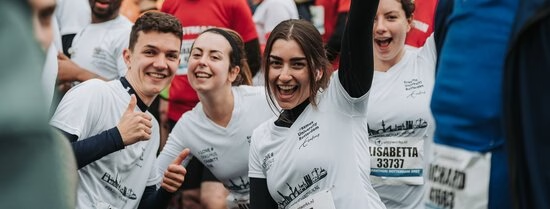
The Erasmus Charity Run is a sponsored run where you raise money for students who dream of studying at Erasmus University Rotterdam. You'll run alongside other participants to raise money for scholarship students.
Would you also like to help fund scholarships for talented students like Julieta? Join the Erasmus Charity Run or donate to make dreams come true.
- Related content
- Related links
- Stichting Erasmus Trustfonds


