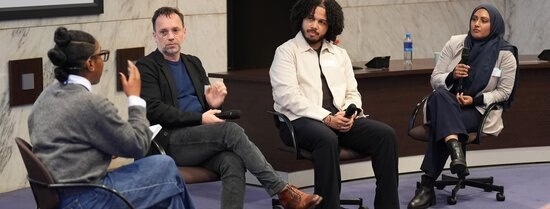
On November 17th, 2026, EUR hosted the second edition of the event Fostering Inclusive Engagement. At this LDE (Leiden Delft Erasmus) event, initiated by IDEA Center, participants deepened their understanding of inclusive engagement through inspiring keynotes and an engaging panel, and by experiencing working in an inclusive engaged way in break-out sessions about inclusive education, inclusive research and inclusive organisation.
Universities aim to engage with society. Meaningful, inclusive engagement is more than simply reaching out or informing. It is about reflecting on who gets to participate, how equitable the collaboration is, whose stories are represented, and whose contributions are recognised.
“One of my key takeaways is that inclusion is not simply about giving everyone a seat at the table. It is about creating an environment where everyone feels empowered to contribute, challenge perspectives, and make a difference. The event was an enriching experience, made even more valuable by the opportunity to connect and exchange perspectives with inspiring colleagues from other universities.” - dr. Alfredo Trovato, Lead Education Coordinator at Rotterdam School of Management at EUR.
Keynote
In their keynote, Dr. Rachel Anne Gillett (Universiteit Utrecht) and Sherlock Telgt (ATANA Noord-Nederland) showcased successes, struggles, and co-creative strategies from the inclusive engagement project Re/Presenting Europe. Their key takeaway really struck a chord with the audience:
“Contact-making and relationship-building with relevant community organisations and representatives is labour-intensive, fraught with cultural misunderstandings, even distrust and require careful as well as sustained management of community expectations and possibly competing interests… Yet such long timescales can be underestimated within funding criteria; often restricting input to certain organised sections of communities (the ‘usual suspects’) and a corresponding absence of wider, unorganised communities and voices.” (Humphrey 2012, p.110).
Panel with LDE engaged researchers
Led by host and moderator Telisiën Windster, a panel of LDE engaged researchers dove deeper into good practices of inclusive engaged research. Dr. Tanachia Ashikali (Universiteit Leiden), Dr. Dirk van den Heuvel (TU Delft) and Dr. Daudi van Veen (Erasmus Universiteit Rotterdam) addressed important questions, topics and challenges like: What happens when the knowledge or expertise of communities and societal partners does not fit conventional academic definitions of expertise or evidence? What can we do to value different forms of knowledge more equitably?
Furthermore, they talked about the fact that inclusive engagement requires relational work, which often takes time, resources, and other efforts not typically recognised in academia. How do we ensure that these efforts are recognised and valued, both for the academics and societal partners? Time, and money (It’s all about the money) were mentioned as most important, which was well recognised by the participants in the room.
Break-out sessions
Three break-out sessions on inclusive education, inclusive research and inclusive organisation, gave participants the opportunity to experience working in an inclusive engaged way themselves. The session on inclusive education focused on Universal Design for Learning (UDL) in practice. Yumna Asaf and Angelique Verhoef presented an interactive session which introduced the core ideas and principles of (UDL), explored how proactive and flexible course design can reduce unnecessary barriers and discussed practical ways to make teaching, learning activities and assessment more inclusive.
The break-out session on inclusive research was set up by Helen Tibboel and Chiara Stenico. In the session - How do you build genuine community engagement when time and resources are limited? - Dr. Katharina Bauer (EUR) moderated a panel with Juliana Gonçalves (TU Delft), Anne van Hazel (Leiden University), Thomas Swerts (EUR) and Siobhan Airey (EUR) on how to conduct inclusive, community-engaged research within tight constraints. After that, participants worked in groups where they explored strategies for meaningful and equitable participation, and overcoming barriers to inclusion - and what funders and institutions could do to support this work.
Dagmar Heemskerk, Dialogue, Process and Deep Democracy Trainer and Facilitator at Perspectivity, hosted the session on inclusive organisation. Power, ranking and group dynamics shape who feels able to speak up and whose voices are heard - often without us being aware of it. In this interactive session using Deep Democracy, participants explored how these dynamics influence our (inclusive) organisation, reflect on how we can better hear and value all voices, and experience how Deep Democracy can help create space for different perspectives to emerge and shape the conversation.
Reflective closure
The reflective closure by Amalia Deekman of Kenniscentrum Ongelijkheid (Centre of Expertise on Inequality)) and Jacco van Sterkenburg, Chief Diversity Officer at EUR, was short but sweet, and very insightful. After all input and insights of the afternoon, it gave even more food for thought, and opened the doors to lively conversations at the drinks and bites.
- Related content


