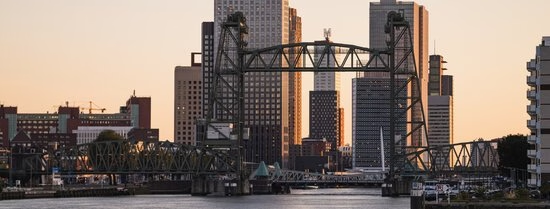
The HefHouse is a unique venue at the foot of De Hef. It is a place for socialising and learning. Young people, local residents and students come together here to learn and develop. Everything is organised for the neighbourhood and by the neighbourhood. To mark its fifth anniversary, we speak to the key players: the L.E.S. Foundation, the local council and the university.
For many young people in the Feijenoord neighbourhood, the HefHouse is a familiar place. 'Its reach is fantastic,' says Jacco Bakker, who is involved with the HefHouse on behalf of Rotterdam City Council. 'The L.E.S. youth hub is based here alongside the university. The council is involved through a grant and by letting out the premises. It’s a winning formula. The hub is run by young people from the neighbourhood. That makes it feel familiar, which in turn makes it easy to pop in.'
What is the L.E.S. Foundation?
It is a charity dedicated to supporting young people in Feijenoord. The foundation focuses on strengthening the community, providing opportunities and preventing young people from turning to crime. Young people are also given plenty of freedom within the foundation. For example, they can visit the HefHouse for activities, support and to develop their talents. The foundation is deeply rooted in the neighbourhood and maintains close ties with residents, parents and local businesses. This means they pick up on many signs and can respond quickly to what is happening in the neighbourhood.

Young people discover what their talents are
'The HefHouse is open to young people five days a week, and sometimes at the weekend too,' says Safouane Azzarouali, one of the founders of the L.E.S. Foundation. Half of the building is used by the university, and the other half is the youth hub. In their "living room" there are two PlayStations, a table tennis table and sofas. 'That’s mainly a way of reaching young people in an accessible way and building a relationship of trust,' explains Safouane. 'Only then does our work really begin.'
Safouane: 'The boys and girls from the neighbourhood have been coming here since they were very young. When they come through our doors, we have a chat: what do you want to learn, what are your talents, what would you like to try? We look for something that really suits the young person. Among other things, we have a music studio, a hairdressing academy and educational activities in the neighbourhood. It’s a very broad range of activities, and you can really see the young people improving in the things they do.'
Education & society come together
At HefHouse, Erasmus University shows students and lecturers which societal issues are at play in the community. You can’t do that from the campus; you have to be right there in the neighbourhood itself. 'It really is a completely different way of teaching. We now have an enthusiastic group of lecturers who are taking on this challenge. Because not everything is set in stone, it also involves a lot of figuring things out for the lecturers,' says Frieda Franke, the university’s HefHouse project coordinator.
'The students have a completely different learning experience to the one on campus. It’s rawer, more practice-oriented, and you’re right in the heart of the Feijenoord neighbourhood. Some students have never even been to Rotterdam Zuid before. It’s all incredibly educational,' says Frieda. Because the university is based in the HefHouse, it also feels a bit closer to home for young people from the neighbourhood. 'For young people from Feijenoord, studying at university can feel a world away. So, it helps enormously that they can get to know the university and its students right here in the HefHouse,' explains Safouane.

One example is the Bildung Climate School. Students from vocational education (Mbo), university of applied sciences and university programmes attend a series of lessons together at the HefHouse, where they collaborate on social issues relating to sustainability and climate change. 'Some students are also working with the L.E.S. Foundation to make the building more sustainable,' explains Safouane.
The highlights of five years of HefHouse
For Frieda, the most important thing is that the university has a permanent presence in the neighbourhood. 'That involves a different way of working: one that’s more neighbourhood focused. So, looking at what the neighbourhood needs and how we, as a university, can contribute to that. That’s what we’re trying to do here at the HefHouse. All too often, it’s still the other way round, without the neighbourhood getting anything in return.'
'Where we are now is truly a high point,' says Safouane. 'There used to be almost nothing for young people in the neighbourhood, and now we have the HefHouse with all its activities.' However, he wants to highlight one particular development: a young man from the neighbourhood who used to visit the HefHouse regularly is now on the neighbourhood council. 'That’s Sayfeddine Lamnaour. He was very involved with the HefHouse and learnt a great deal here. He used all that knowledge to stand for election to the neighbourhood council. That also ties in with our vision of youth participation. We don’t just want to offer young people activities; we also want to encourage them to take responsibility, make their voices heard and, ultimately, make a difference to their local community themselves.'

Jacco highlights a moment that he considers typical of the HefHouse: 'A year ago, a whole host of councillors came to visit the HefHouse. Kürşat Kayhan, the founder of the L.E.S. Foundation and the HefHouse, was invited to give a talk. He couldn’t resist pointing out that more funding was needed. That wasn’t exactly well received by the councillor responsible at the time, but the money did eventually come through. I think it’s brilliant that someone managed to pull that off. That’s exactly how the HefHouse came to be. Kürşat got into a discussion with the local police officer about the fact that there was nothing for young people to do in the neighbourhood. That’s ultimately how the HefHouse came about. People like Kürşat make a difference and are exactly what we need.'
The future of the HefHouse
The HefHouse must stay. Frieda, Jacco and Safouane all agree on that. 'We need to keep the core, but give it a fresher look,' says Safouane. That fresher look relates to the old building that currently houses the HefHouse. In the summer, for example, it gets sweltering in the building, and you can’t really do anything. 'That’s a valid point. We need to ensure that the programmes here can carry on in the summer when it’s extremely hot. But that costs money, and that’s often where the friction lies,' says Jacco.
At an administrative level, within the local authority and the university, it is often said that they consider the HefHouse important. But that does not always translate into resources and funding. And that is essential if the HefHouse is to remain successful. 'Looking ahead, I think the most important thing is that this place continues to exist right in the heart of the neighbourhood. We need to move towards a situation where the neighbourhood identifies its own needs and where we, as a university, might be able to play a part in meeting them. That we give something rather than take. Ultimately, this also ties in perfectly with our own strategy of being an engaged university,' Frieda concludes.
- More information
- Related content


