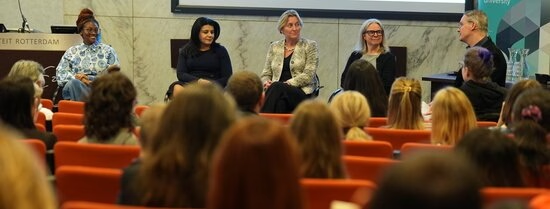
On March 2nd, 2026, IDEA Center organised an event in honour of International Women’s Day: ‘Exploring health, gender and intersectionality’. The Senaatszaal was filled with students and staff from EUR and Erasmus MC. A lively dialogue ensued on how we can create more inclusive health care. What do we need on a research, political, and organisational level? What can each of us personally do to make health care more inclusive?
For many years, white males were used as the standard in healthcare - in research, in the development of medicine, and in treatments. Fortunately, in recent years, more attention has been given to the differences that exist between people in terms of gender, ethnicity, age, etc. During the event our speakers reflected on these aspects, highlighting how essential they are if we want to provide high quality care to all.
Prof. Jantine Schuit, Rector Magnificus of EUR, and prof. Jacco van Sterkenburg, the new Chief Diversity Officer at EUR, warmly welcomed everyone, and emphasised the importance of days like International Women’s Day, and of the topicon the agenda.
Prof. Jantine Schuit: “Today’s topic is so important. It’s close to my heart, and close to research I did before I became rector. It is crucial to take into account gender differences in health care. Due to societal gender norms, women are often busy with caring for others, and they subsequently forget their own health. When they do go to the GP, their symptoms are regularly being put down as relating to, or being caused by, stress. So, in that way, women are suffering twice.”
Prof. Jacco van Sterkenburg linked the themes of gender and intersectionality to a broader perspective. He focused on the world of sports media, which is his field of expertise and research. “There are parallels between health care and sports media: in sports media there can be a lot of racialised and gendered communication. For example, women athletes are often associated with emotions and stress, whereas men athletes are associated with rationality, stability and being able to deal with pressure. Another example is that athletes of colour are often considered to be naturally gifted, whereas white athletes are seen as hard-working.”

Opening speech by prof. Sabine Oertelt-Prigione
Prof. Sabine Oertelt-Prigione, professor of sex- and gender-sensitive medicine at Radboudumc, and at the University of Bielefeld, set the scene for the event in her opening speech. Amongst others, she shared possible consequences of ignoring gender differences in health care. “A mechanism that occurs in health care is when expected symptoms are not there. For example: asthma is associated with wheezing, which is mostly the case for boys. Yet, it is a less common manifestation for girls. So for girls, asthma might not be diagnosed as soon if they are not wheezing.
Another mechanism is that there are stereotypes about diseases. So, when a certain disease is more perceived as fitting one gender than the other, the likelihood of being screened for that disease is lower when you don’t fit the image. There are a lot of examples where men and women are diagnosed differently. Regarding MS for example, when symptoms aren’t always clear, men first are sent to an orthopaedic surgeon, whilst women are sent to a psychiatrist more often.”
“Nowadays, there is also an algorithmic bias. You can find several examples under the hashtag #deathbychatbot. Chatbots are trained by historical data, so the existing bias is taken along. Data is not neutral. For example, if you typed in a (medical) chatbot that you are a smoker, who has had a painful left arm for the last hour and that you’re feelings sweaty and sick. And then indicated that you are a man, the results would indicate that you might have heart problems, and needed urgent care. If you indicated that you are a woman, the first and second option presented were a panic attack and depression”.
Panel talk
Prof. Sabine Oertelt-Prigione was joined by three experts of Erasmus MC, each with their own contribution to, and perspective on, the topics of health, gender and intersectionality. Merel Dap, researcher Social Obstetrics at Erasmus MC and regional coordinator Perinatal audit for the Southwest of the Netherlands, prof. Maryam Kavousi, professor of Population Cardiovascular Health at Erasmus MC and prof. Hanneke Takkenberg, Executive Director of ECWO, Erasmus Centre for Women and Organisations, and Co-Director of Netherlands Women’s Health Research & Innovation Center at Erasmus MC took the stage for the panel talk.
The panelists talked about ways in which we can create a more inclusive health care. Should we start at medical schools? The answer was: yes, definitely. This is where we educate our future health care professionals. Merel Dap: “There have been changes in the curriculum in the meantime, but when I was studying medicine, one of our textbooks about breast examination stated: “healthy nipples are pink”, and I was thinking: no one I know has pink nipples.”
Merel Dap: “Another important aspect is: doctors make doctors. A lot of medical students have parents who studied medicine. They are also often from high income backgrounds. So, I remember some of my colleagues coming into social housing for the first time and being shocked and surprised by the small size of the apartment and how people lived. And I thought: but this is how many people I know, live. This raises the question whether they will understand the circumstances of these people, their struggles and where they come from.”
Hanneke Takkenberg: “In medical education, we tried to be more diverse and open, but then students started doing the internships and we noticed that the systems were not ready for diverse and open doctors. So, it is not enough to make changes in the curriculum, it needs to work in tandem: start in medical schools but we simultaneously need to change the climate in broader medicine.”
Representation of the broader society
Maryam Kavousi: “Regarding (medical) research: we think we’re doing a lot already to make research more inclusive but that is often not the case yet. A lot of generic stuff, about for example inclusion and diversity, is put in grant applications without actually thinking about what role it would play or what researchers want to do with it. Then eventually, they do not know how to apply what they put in the application, or they find a way around it, or an excuse as to why it was not possible to take diversity into account. One should always start with the research question: is it applicable to all communities? We have to really do this in practice: we have to conduct multidisciplinary research to fill in the gaps to create meaningful platforms.”
Hanneke Takkenberg: “We have to learn from what is in society and make use of expert knowledge and lived experience.”
Sabine Oertelt-Prigione: “Health care is often talked about as disjoint from society, but it is actually a representation of the broader society. So, whatever you do to combat inequality will reflect back on health care - and other parts of society.”
- Related content


