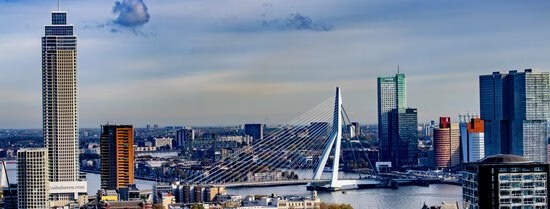
There is less and less space for cars in Rotterdam. 'And that’s a very positive thing,' says mobility economist Giuliano Mingardo. 'It’s good for the quality of life and the economy.' Rotterdam is actually rather late in making its city centre car-free. Many other European cities did this years ago.
The previous Rotterdam city council began the process of keeping cars out of the city centre. The new coalition of Pro, D66, VVD, CDA and Volt is building on that work. 'Forty years ago, cars had free rein in the city. For over 10 years now, Rotterdam has been working to give that space back to people,' says Mingardo.
Fewer cars, more turnover
According to Mingardo, it is good that Rotterdam is pressing ahead. 'As scientists, we have been advocating this for a long time. The first studies date back to 2007. They already showed that banning cars from the city centre is beneficial for the city.'
The scientist cites the first benefit as being that streets in the city centre become more attractive and safer without cars. 'Closing streets to traffic often goes hand in hand with street regeneration: more greenery, benches and footpaths. This makes the street more appealing. In principle, that’s also good for business.' Yet business owners often believe the opposite. They fear that fewer cars will mean fewer customers.

According to Mingardo, this is one of the most persistent misconceptions in his field: 'It’s a myth. It really isn’t true. In fact, it’s the other way round. Fewer cars on the street actually bring in more customers and therefore more turnover. It’s very simple: a car doesn’t spend money; people do. So, as a shopkeeper, a car parked outside your shop is of no use to you.'
A brief biography of Giuliano Mingardo
Giuliano Mingardo works at Erasmus UPT. He is a senior researcher specialising in parking policy and urban mobility. His research focuses on understanding how people get around in and around cities. He also examines how policy, spatial planning and the quality of the living environment can influence people’s mobility behaviour. Giuliano regularly advises (local) authorities and businesses on these topics.
One downside of a car-free city centre
If a city becomes too beautiful and attractive, rents go up. That can be a downside of car-free streets in the city centre. 'But because there’s a good chance your turnover will also rise, in the long term it’s more of a problem for residents,' says Mingardo.

More attractive cities also attract tourism. Take Amsterdam, for example. There, you can see the problems that tourism can cause: 'Fortunately, we don’t have many TikTok queues in Rotterdam yet. But look at Katendrecht. You can clearly see gentrification there. Ultimately, the poorer residents will no longer be able to live there. In the long term, that can also be a downside of low-traffic cities that become "too attractive".'
Paid parking isn’t meant to annoy people
Rotterdam is also introducing paid parking within the entire ring road. This has sparked a lot of reactions across the city. 'I understand why people are complaining. Nobody likes paying,' says Mingardo. 'There’s a lot of emotion attached to cars. They’re synonymous with freedom. So you can expect a lot of angry reactions. Especially when you’re switching from free to paid parking. That’s the hardest step. Raising existing parking rates is easier. In the city centre, rates are already high, so an extra increase is less noticeable to people.'
The council is not introducing paid parking to make life difficult for residents. 'That is the key message'” said Mingardo. 'As a council, you do need to communicate this clearly. We could do better in that respect. At the moment, people see it as a cash cow. Of course, it brings in money, but that goes into the council’s general budget. It goes towards things that are good for the city. You need to communicate that clearly.'

Encouraging people to use public transport and to cycle
Introducing paid parking in all neighbourhoods acts as a steering mechanism, according to the researcher. 'You steer people towards an alternative, such as walking, cycling or public transport. People are more likely to opt for these because of the high parking costs.'
So the aim is to encourage visitors to come by car less often. Residents themselves will be issued with a parking permit. Mingardo: 'And these are very cheap. So not much will change for residents. The advantage is that you’ll be less bothered by visitors using "your parking space". You see this, for example, in Overschie, where people going on holiday by plane leave their cars parked in the neighbourhood for long periods.'
Take other car-free cities as an example
'You’d better get used to fewer cars in the city centre and paid parking within the ring road. That’s not going to be reversed. No city has ever gone back on measures like this. It’s not as if cities will go and build a busy road through the city centre again later on,' says Mingardo.
Rotterdam must continue along this path, says the researcher. 'The resistance at the start is the hardest part. My advice is: don’t be afraid! Take other cities as an example. Ljubljana (the capital of Slovenia) has one of the most attractive car-free city centres in Europe. It’s a trend everywhere. Oxford Street in London is now also largely car-free. Rotterdam is actually lagging behind a bit with all those cars in the city centre. And if it’s happening everywhere, it’s clearly not such a bad idea after all.'
- More information
Press related questions?
Please contact Ronald de Groot, press officer at the Erasmus School of Economics, by email or by telephone on +316 53 64 18 46.Erasmus UPT is the center for Urban, Port and Transport Economics, where we combine academic expertise with practical solutions for governments and businesses. Discover more
More science stories? Have a look at our online magazine Erasmus Extra.
- Related content


