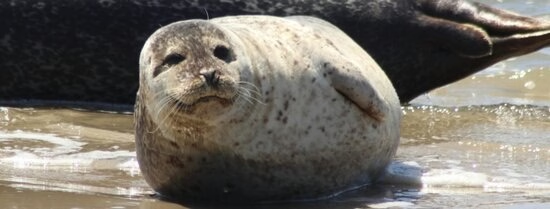
What can communication in seals tell us about the evolution of human language? EUC lecturer Koen de Reus recorded 1000 hours of seal calls to better understand this and discovered that seals’ vocal communication shares several characteristics with human speech, including the development of regional accents.
Understanding human language through animal communication
Anyone who has ever tried to communicate something to a beloved pet knows that human and animal communication is leagues apart. But that doesn’t mean there are no similarities: in fact, many animals use surprisingly complex communication systems, and some species can ‘learn vocally’: they’re able to learn new sounds.
This opens up opportunities to better understand the evolution of human language. Back in the 1980s, researchers discovered that seals are vocal learners, able to imitate human speech.
Erasmus University College lecturer Koen de Reus continued this line of enquiry with his PhD research at Radboud University and Vrije Universiteit Brussel, in collaboration with the Max Planck Institute for Psycholinguistics and Sealcentre Pieterburen (now located in WEC Lauwersoog).
Seals with accents
For his research, d e Reus combined behavioural experiments with anatomical measurements of seal vocal tracts, and recorded over 1000 hours of seal pup calls. Analysis revealed several similarities between pup calls and human speech.
One such trait is that seal pups wait for others to finish calling before speaking up themselves. They take turns, like humans do in conversation. This suggests that seals are much more social than previously believed.
The recordings also revealed that over time, seal pups in close proximity to each other started to sound more alike – comparable to local accents among humans.
Not as unique as we think
The charm factor of baby seals being able to develop accents is clear. But this research can also help scientists better understand the evolution of language.
“With this research, I wanted to show that humans are not as unique as we think,” says de Reus. “Every animal has its own communication system. By comparing them, we can learn more about how such systems evolved, including our own.”
de Reus is currently a Life Sciences lecturer at Erasmus University College, which offers an interdisciplinary Liberal Arts & Sciences programme, and has a background in Liberal Arts & Sciences himself.
“One of the things I love about this research is that I am not bound to any specific discipline. My work draws on perspectives and methods from several fields to learn about animal behaviour and human evolution, combining ideas from animal biology, cognitive science, linguistics, acoustics, anatomy, and many more,” says de Reus.
- Researcher
- More information
Read the original research here or read the summary on BBC Science Focus.
To hear more about this research, you can watch Dr Koen de Reus on Studio Erasmus on 14 April.
For more information please contact Marjolein Kooistra, communications advisor at Erasmus School of Social and Behavioural Sciences: kooistra@essb.eur.nl.
