Elin de Baan grew up in Rotterdam, completed her Bachelor’s in History at Erasmus University Rotterdam, and earned her Master’s in Urban and Architectural History (cum laude) at the University of Amsterdam. She went to work for an urban development agency, and that was where the conventional part of her CV ends. She has since farmed seaweed in Ireland, herded sheep in New Zealand, and recently started as a project manager at a large Dutch organic-waste recycling company. We spoke to her to find out whether there’s a method to her striking choices.
On paper, accepting a job at an urban development agency after her Master’s in Urban and Architectural History looked like the obvious next step, Elin explains. But her heart, it turned out, lay elsewhere. “It was a really nice employer, but after a few months something started to feel off. We talked constantly about sustainable building and sustainable urban development, but whenever I asked people at conferences how we were actually going to do that in practice, the answers never really satisfied me.”
She resigned, moved to Denmark, and enrolled at an Organic Farming School there. “I’d heard about it by word of mouth and thought: this is where I can learn how everything works in practice. I could see a clear connection, for instance, between agriculture and sustainable building materials, and I really wanted to explore that.”
The most beautiful place in the world
Her new studies opened the door to all kinds of international adventures, which she talks about with great enthusiasm. “A big chunk of the program is gaining work experience, and you get to choose where. I spent time in Ireland on a seaweed farm, because I saw seaweed as a promising building material. Seaweed cultivation is still small in Europe, and it’s a fast-moving market with a lot of experimentation going on. Thinking and doing beautifully came together there. I also spent a short stint in Italy at a more traditional farm."

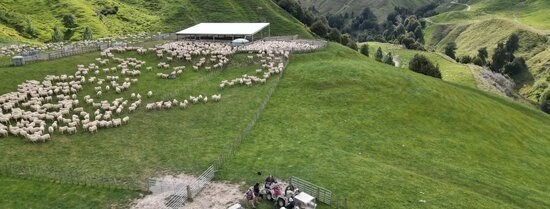
"And for the last two years of my studies I worked as a shepherd in New Zealand, because I’d become interested in wool. I worked on a farm, a ‘station’, as they call it, of 6,000 hectares, with 30,000 sheep, 3,000 head of cattle, and a team that, for the most part, consisted of dogs.” Her gaze drifts off. “I think that however old I get, I’ll always say those were the most beautiful years of my life... For me there’s no place on earth more beautiful... Before the sun even comes up, you’re out on your quad bike watching the mountains wake up around you. Deer, peacocks, sheep everywhere. Breathtaking views. That work kept me humble, in a way. There’s very little room for ego, or for grand thoughts about yourself. By the end of the day you’re covered in mud, dung, and blood, and the next day you do it all again. There’s no messing around, just hard work.”
Sustainability is something you do
She believes this mindset will serve her well in her future career. “I don’t want to spend endless hours sitting around the table talking. I think a proactive attitude can really help with sustainability issues by looking at what we can do right now, at this very moment. Those steps might be small, but they’re still progress. Ideally I’d love for us to solve everything tomorrow, but I also know that’s simply less realistic than working towards it step by step.”

Elin is now back in the Netherlands, and will work as a project manager at a large organic-waste recycling company that turns municipal green waste into biogas, compost and liquid CO₂. It’s partly a practical choice, as she needs an income now that she’s moved back, but it’s also a choice that lets her, as a theorist, get her hands dirty. “My CV baffles a lot of people, because it goes off in all directions. They’re impressed, but they also think: what are we supposed to do with this? The Dutch labour market isn’t exactly forgiving in that respect. But my new employer was specifically looking for someone with my profile: research skills combined with a practical, agricultural background. What I really like is that they’re paying for my tetanus and hepatitis shots, as it means that alongside the theoretical work, I’ll also simply be standing among the green waste in my work boots. And that feels like a perfect match to me. I’m actually proud of my broad background, and really motivated to put everything I know into practice.”

Don't plan too far ahead
Yet her current job does not seem to be her final destination. She doesn’t know where she’ll eventually end up, or which route she’ll take to get there. “In the past, I sometimes call it my previous life, before I started doing all this, I used to think years ahead. I always had some idea of what was coming. Since I started working in agriculture, that’s changed. I don’t plan that far ahead any more. I don’t know what I’ll run into along the way, or what will interest me in a year’s time, or who I’ll meet by then. So I’ve also found a lot of beauty in leaving that open, and just looking at what’s in front of me here and now.”
Dare to dream
Her main advice to fellow alumni would be to follow their own path and chase their dreams. “I think a lot of people dream, but leave it at that. They invent reasons why something isn’t possible. I think that’s a shame, because often you can make your dreams come true just by taking that first step. And your career path really doesn’t have to be a straight line. It can be incredibly useful to gain experience in all kinds of different fields related to your specialism. Even if other people don’t immediately understand your path, what matters is that you understand it. I think that in the near future we’ll need bridge-builders. People who can connect different worlds, especially where we find ourselves on opposing sides. Take the nitrogen issue, for example, and the role farmers play in it. I don’t think farmers are simply victims, but I do have sympathy for them, because I also know how hard they work. If you don’t just read the policy documents but also delve into the practical reality, you discover that different narratives exist side by side. And every narrative holds a kernel of truth.”
- More information
- Related content


