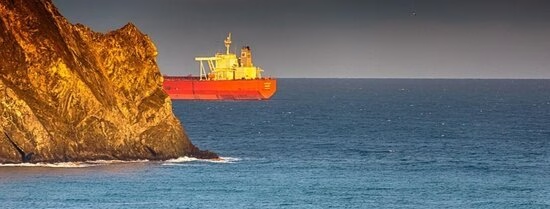
Pollution risk exposure in European waters has surged dramatically over the past years, driven largely by the growing presence of so-called “shadow fleet” vessels operating outside conventional regulatory and insurance frameworks. This is the outcome of a study, led by Sabine Knapp, an affiliated researcher from Erasmus School of Economics.
Sabine Knapp provides the most comprehensive assessment to date of pollution risk exposure for Portugal and the Baltic Sea region, with particular focus on tanker traffic affected by recent geopolitical sanctions. Drawing on more than 45 million ship-level risk estimates between 2021 and 2024, her study quantifies potential incident costs associated with maritime operations and highlights a troubling shift in trade patterns and safety standards.
According to the findings, pollution risk exposure in the Gulf of Finland alone increased by more than 100 percent from 2023 to 2024. Across the wider Baltic region, an estimated USD 68.8 million in total maritime risk exposure (nearly 10 percent of the regional total) is potentially uninsured, rising to 17 percent in the Gulf of Finland. Much of this risk is linked to vessels associated with the shadow fleet, a loosely defined group of ships often used to circumvent sanctions and regulatory oversight.
The study shows that more than half of the pollution risk exposure in the Gulf of Finland is associated with vessels identified on a newly developed shadow fleet watchlist, compared to a global average of just over 16 percent. Sanctioned vessels alone account for nearly one-third of the region’s pollution risk. These figures point to a growing concentration of environmental and financial risk in key European maritime corridors.
Machine learning sheds light on sanction compliance
Using advanced machine learning techniques, Sabine Knapp (together with researchers Michel van de Velden and Philip Hans Franses of Erasmus School of Economics) developed a prediction model that successfully identifies vessels likely to be sanctioned based on safety quality, insurance status, age, size, and operational behaviour. The model demonstrates strong predictive power and links poor safety quality of vessels in terms of incident risk are closely linked to sanction non-compliance.
The research also highlights significant changes in tanker trade routes following sanctions on Russian exports. Tankers are now traveling longer distances through European Union waters, including the Mediterranean, increasing exposure to potential incidents. While nautical miles traveled by chemical and product tankers in the Baltic have declined, oil tanker traffic has increased, contributing further to rising pollution risk exposure.
Strengthening maritime domain awareness
Beyond quantifying risk, the study emphasises the importance of integrating ship-specific risk profiles by taking a multi-dimensional risk approach with live AIS tracking data to improve maritime
domain awareness. Such systems could help coastal states detect high-risk vessels earlier, trigger targeted monitoring, and support faster response to potential dangerous situation such as pollution events.
‘The emergence of shadow fleets is fundamentally changing the risk landscape in European waters,’ Knapp says. ‘By linking safety performance, behavioural indicators, and real-time vessel movements, authorities could better understand where risks are rising and intervene before costly environmental incidents occur.’
The study offers valuable insights for policymakers, insurers, regulators, and maritime stakeholders seeking to navigate an increasingly complex and uncertain shipping environment. It also lays the groundwork for future additional research to include additional behavioral indicators such as AIS spoofing and silent operations into the prediction model.
About Sabine Knapp
Sabine Knapp is an affiliated researcher at Erasmus School of Economics where she obtained her PhD in 2007. Since then, she has worked for several regulators in the maritime industry including the European Maritime Safety Agency (EMSA) in Lisbon, the International Maritime Organization (IMO) in London and the Australian Maritime Safety Agency (AMSA) in Australia. Since 2015, she is an independent consultant via her company Seven Ocean Research Pty Ltd promoting science-based advice. She runs a weekly risk prediction routine of the world fleet based on prediction models covering several risk dimensions. To promote transparency, most of her work is published and peer reviewed and some is open access. Her work is driven by a passion for enhancing maritime safety and environmental protection.
- More information
The full study, titled “Pollution risk exposure assessment for Portugal and the Baltic Sea with an emphasis on shadow fleets,” is available in Marine Pollution Bulletin. Recently published work on multi-dimensional risk profiling and the evaluation of the status quo of risk profiling in the maritime industry is available in Artificial Intelligence for Transportation.
For more information, please contact Ronald de Groot, Media & Public Relations Officer at Erasmus School of Economics: rdegroot@ese.eur.nl, +31 6 53 641 846.
