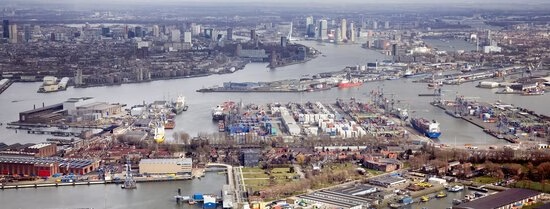
Erasmus University Rotterdam will work with TNO, FME, STC and RTC to develop new learning environments for current and future professionals in the Rotterdam Harbour Industrial Complex. The Smart Education 4 Future HIC project has been awarded €880,778.45 in funding from the Just Transition Fund (JTF) Rijnmond.
The energy and raw materials transition is fundamentally changing work in the Port of Rotterdam. Industrial processes are becoming increasingly electrified, digitalisation is playing a growing role, and new energy carriers such as hydrogen are being introduced. These developments require professionals who understand new technologies and can collaborate across disciplines, roles and educational levels.

Learning through current challenges from the port
As part of Smart Education 4 Future HIC, the partners will develop so-called Action Rooms. These are innovative, practice-oriented learning environments in which students and professionals work together on complex challenges from the port and industry.
Participants will use digital twins: virtual models of installations, production processes and energy systems. In a safe digital environment, they can explore different scenarios, make decisions and immediately experience the consequences of those decisions.
A challenge might involve the production and storage of hydrogen, preventing equipment failure or making intelligent use of limited energy capacity. Rather than approaching such a challenge solely from their own area of expertise, technicians, business professionals, operators, designers and other participants work together to find solutions.
In this way, participants develop technical and digital expertise alongside skills such as collaboration, systems thinking, decision-making and problem-solving.
Education for every stage of a professional career
The project is aimed at students as well as professionals, jobseekers and people looking to reskill or upskill. The Action Rooms can be used in regular degree programmes, short courses, corporate academies and other forms of professional education.
This closely aligns with Erasmus University Rotterdam’s ambition to make academic knowledge accessible to people at every stage of their careers. Learning does not stop when someone completes a degree. Particularly in sectors undergoing rapid change, professionals need opportunities to continue developing throughout their working lives.
Techniek College Rotterdam and STC Rotterdam will contribute to the development and application of the learning environments from the perspective of vocational education. This will enable participants from different educational levels – from vocational education to university – to learn with and from one another.

Bringing academic knowledge and professional practice together
Erasmus University Rotterdam will lead the development of the educational concept underpinning the Action Rooms. Educational expertise in experiential and collaborative learning will be connected to current challenges from professional practice.
TNO will develop the accompanying open-source digital twin platform, while FME will provide the connection with companies in the technology industry. Businesses and other organisations in the port area will contribute practical knowledge and real-world challenges, ensuring that the learning environments remain closely connected to developments in the workplace.
The collaboration between academia, education and industry is essential. The energy transition is not solely a technological challenge. It also calls for new ways of learning, working and collaborating.

An integrated approach to innovation is essential to the energy transition
"Technological innovation alone is not enough: real impact emerges when technology is combined with the development of people. This project demonstrates how new digital possibilities can be connected to new ways of learning and collaborating. In doing so, we are not only developing smart solutions, but also enabling professionals to apply and further develop these solutions in practice.”
Daniel van Vliet
Programme Director Lifelong Learning, Erasmus University Rotterdam
Creating lasting positive societal impact
During the three-year project, at least two Action Rooms will be developed and tested. The partners will also create an open-source toolbox containing digital twins and educational applications.
By making the results openly available, other educational institutions, researchers and companies will be able to use and further develop them. In this way, Smart Education 4 Future HIC will continue to contribute to accessible professional education, an agile and resilient workforce, and a sustainable, future-proof port region after the project has ended.
Smart Education 4 Future HIC will run from 1 Augustus 2026 to 31 July 2029. The project is coordinated by TNO and carried out with Erasmus University Rotterdam and FME, in collaboration with educational institutions and companies from the region.
- More information
More information about the JTF (Just Transition Fund) can be found here. For further questions regarding this project, EDGE (Erasmus Department for Professional Growth & Continuing Education) can be contacted at ovp@eur.nl .
