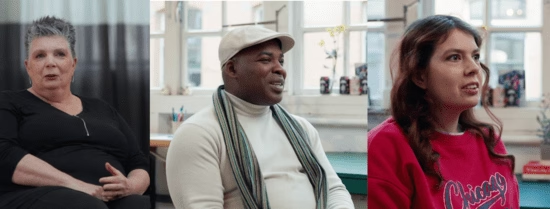
How can cities prevent young people from getting pulled into crime? Why do so many residents seeking support get lost in a maze of agencies, forms and systems? And how can development plans better reflect what a neighborhood actually needs? Local residents are often the best researchers when it comes to questions like these, as the documentary Happy Socks: The Movie shows. But their knowledge still doesn’t play a large enough role in policy and decision-making about the city.
It’s a busy Wednesday morning at Gemaal op Zuid in Rotterdam, home to the Afrikaanderwijk Cooperative. In the neighborhood kitchen, large pans are simmering on the stove for a catering order. Outside, at the Grondstoffenstation resource station, a team started early collecting and sorting waste from the Afrikaandermarkt.
Dozens of residents from the Afrikaanderwijk do paid work through the cooperative. Work that was once often outsourced to companies from outside the neighborhood is now organized locally and carried out by residents themselves. In addition to catering, waste processing, cleaning and textile production, residents also work as researchers. They put important issues on the agenda, design research projects and carry them out together with academics.
Wijkwijs
The Afrikaanderwijk Cooperative is part of Wijkwijs, a collective of Rotterdammers and knowledge partners who work together on issues that residents themselves consider important.
“We try to do research in a different way,” says Wijkwijs researcher Els Leclercq of Design & Publics in the documentary, which features interviews with residents, researchers and others involved at Gemaal op Zuid. Within Wijkwijs, residents are more than research participants. And they are more than co-researchers, Leclercq says. They are the driving force behind the research.

This marks a break with the traditional model of academic research, in which scholars conduct studies and publish their findings in academic journals. Although citizens are increasingly involved in research, it is rarely done in their service or under their leadership.
The maze of service counters
The documentary shows what this radically different approach to research looks like in practice, and why it produces vital knowledge for a city like Rotterdam. Residents speak, for example, about the “lokettenjungle”: the maze of agencies, forms and regulations people encounter when they seek help.
Rotterdammers who turn to a support organization, mostly because they run into problems that could be relatively easy to solve, often get stuck in the complex systems of social support. In the film, residents explain exactly where things go wrong.

According to Leclercq, this kind of knowledge is difficult to obtain in other ways. “Residents have experiential knowledge and situated knowledge,” she says. That knowledge should be an important foundation for policy in Rotterdam. “This knowledge is needed to make policy more appropriate, more realistic and more just. After all, policy is made for citizens.”
A central role in decision-making
Yet residents are often brought into plans for their neighborhood, and decisions that affect them, only at a late stage. Once the main outlines have already been set, residents may be given the chance to voice an opinion or contribute an idea. “Residents are then asked to participate, while the fundamental choices have already been made,” Leclercq says.
A project in Kralingen-Oost shows that things can be done differently. There, residents and local organizations worked together on a program of requirements for their neighborhood. It sets out what they consider important, for example when it comes to mobility, green space and public amenities. Developers must then show how they have taken those priorities into account in their plans.
“If you give residents a central role in these kinds of processes, different issues come to the table and plans are much better aligned with what is happening in the neighborhood,” says Leclercq.
The best advisers for new policy
According to Marianne van den Anker, Rotterdam’s ombudsman, residents are “the best researchers, advisers and sources of inspiration” when developing new policy for the city. “And they are also the ones who carry it,” she says in the film.

Jurian Edelenbos, professor of public administration at Erasmus University Rotterdam and also involved in Wijkwijs, sees this as part of a broader challenge for local government. Municipalities need residents in order to tackle complex problems around poverty, safety and health, he says. But their input must not merely be collected. It must also be clear that something is being done with it.
Responsive government
This benefits not only residents, but also city government. “The municipality can build trust by acting responsively,” says Edelenbos. “That means taking residents’ input and initiatives seriously and visibly following up on them.”
That does not mean every proposal should be adopted, Edelenbos emphasizes. But residents should be able to see what happens to their input. And if the city cannot respond to needs or suggestions, it should be clear why.
If that follow-up is missing, there are consequences. “If governments say they value input but then do nothing with it, trust erodes.”
From the city to city hall
At Gemaal op Zuid and in other Wijkwijs practices, knowledge is being developed about major issues that both the municipality and residents are grappling with: from work and income to social support and safety, and from heat stress and flooding to the housing market.
But at present, this knowledge does not automatically find its way to city hall. Leclercq, Edelenbos and other Wijkwijs researchers argue that residents should be structurally involved in plans and decisions about the city.
Universities and knowledge institutions, too, are working to give citizens a central place in the production of knowledge. Erasmus University Rotterdam, TU Delft, Leiden University, Erasmus MC and Leiden University Medical Center, for example, have joined forces the Hub for Impactful and Engaged Research (HIER). Through the hub, the universities aim to strengthen the role of citizen science and connect existing initiatives that are still highly fragmented.
“We need a shift,” says Leclercq. “From consultation after the fact to genuine co-creation and shared decision-making.”
About the film
Happy Socks: The Movie – The Value of Neighborhood Researchers is a documentary by Studio Roodenburch, made with support from the Resilient Delta initiative. In late 2023, residents from the Afrikaanderwijk and Vreewijk, together with Design & Publics and the Afrikaanderwijk Cooperative, explored what health and well-being mean in their neighborhoods. In the film, neighborhood researchers, designers, academics, the neighborhood cooperative, Rotterdam’s ombudsman and others involved reflect on that process and on the value of knowledge from the neighborhood.
→ Watch the full film here.
→ Watch clips from the film here, grouped by theme.
- More information
Laura van Gelder, Senior science communicator | Convergence | Resilient Delta Initiative
Britt Boeddha van Dongen, communicatieadviseur | Erasmus Initiative Vital Cities and Citizens
