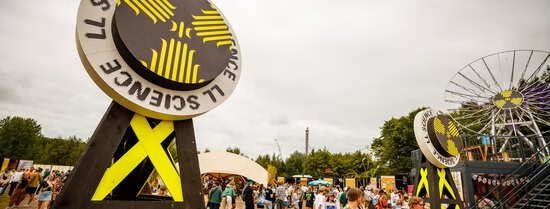
A festival like Lowlands is all about music, mud and moments that linger. However, the festival site is also a laboratory, where thousands of visitors participate in their own research. Erasmus University Rotterdam will be present at Lowlands Science 2026 on 21, 22 en 23 August with three striking studies.
Hot Takes: Quietly Listen to Heated Opinions
Climate, war, feminism, migration, religion, AI, politics. Topics that regularly derail in talk shows, comment sections and at kitchen tables. Young people say that we should deal better with differences of opinion. The question is: what does that look like in practice, on a busy festival site?
During Hot Takes, visitors listen to someone else's outspoken opinion via recorded delivery – a method from the verbatim theatre. The other person is unknown, may think completely differently, and is not there himself. Only the voice remains. The visitor hears the hot take, is given time to respond and reflects on what this does to him or her.
Researchers from the Erasmus SYNC Lab, Healthy Start, TIME OUT and the Hot Politics Lab (UvA) collect experiences and reactions. How does it feel to listen to a dissenting voice without interruptions? Does that lower the tension, or does it evoke resistance? And above all: does it bring people one step closer together?
Tilly: a million cells, infinite clicks
Playing a game and contributing to cancer research at the same time: it sounds almost too good to be true. Yet that is exactly what the game Tilly does at Lowlands Science. Visitors are invited to help annotate a million cells, directly from the laboratories.

With a creative intervention in the form of a digital game environment, festival-goers label cells on a screen. Every click helps train AI algorithms used in cancer research. What is normally hidden in specialist software and scientific articles is now turning into a collective experience, in the middle of the festival hustle and bustle.
Tilly at Lowlands is a collaboration between ChangeGamers, NWO, The Netherlands Cancer Institute, Erasmus University Rotterdam, the Erasmus Graduate School of Social Sciences and the Humanities (EGSH) and AICON. At AICON, the conviction that meaningful impact is created through continuous experimentation, collaboration and exchange is central. In that light, Lowlands functions as a lab: a place where thousands of people show how willing they are to think along, even between two concerts.
Kapsalon Kopzorgen: measuring stress in a festival chair
How much stress does someone literally carry? And how much of that can be seen in the body? Kapsalon Kopzorgen makes these questions surprisingly concrete. Visitors take a seat in a hairdressing salon chair, have a tuft of hair cut and thus get an insight into their own stress level.

Researchers at Erasmus MC measure the amount of hair glucocorticoids – a biomarker for long-term stress – in that hair. In combination with a short questionnaire, a unique comparison is created: the stress levels of festival visitors next to those of young adults who have (had) cancer. For the first time, this will directly look at who is at risk of chronic stress after cancer, and how it can be recognized and treated in time.
Visitors receive their own stress score, including an explanation. The research goes beyond just collecting data. It touches on responsibility and quality of life: what social damage occurs if long-term stress after cancer is not seen, or only late? And what does it say when a seemingly carefree festival-goer has similar stress levels as someone who has had a heavy treatment?
After the haircut, visitors can get a hair upgrade: from glitter in your hair to festival-proof space buns. So that participants walk onto the site with a fresh festival coupe. Or the visitor chooses a relaxing head massage.
- More information
Marjolein Kooistra, communication / press relations Erasmus School of Social and Behavioural Sciences email: kooistra@essb.eur.nl | 06 83676038
Want to find out more about all the research taking place at Lowlands? Have a look at the Lowlands website.
- Related content

