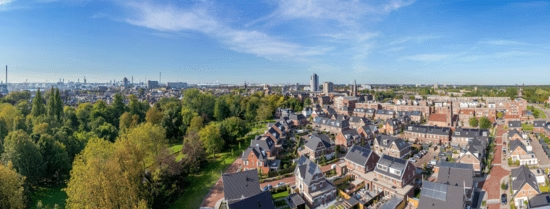
Planting trees alone is not enough to keep cities cool. In the fight against heat, parks and trees will need to be given the same firm place in urban policy as roads and housing in the coming decades. This is the conclusion of a new study on the heat resilience of Vlaardingen, which models the development of urban heat up to 2050.
In the study, researchers Arka Bhattacharyya (TU Delft) and Sylvia Bergh (Erasmus University Rotterdam), together with research assistant Lukas van der Wolf (TU Delft), examine Vlaardingen's heat resilience in the decades ahead.
Their report, which runs thousands of climate scenarios, shows that temperatures in densely built areas can rise by as much as four degrees during heatwaves compared to surrounding areas. The city center and harbour districts are particularly vulnerable to the so-called urban heat island effect.

Stress test for city plans
The municipality of Vlaardingen has ambitious greening plans, including additional trees and shaded spaces. In the study, these plans were "stress-tested" using a Decision Making under Deep Uncertainty model, which simulates a wide range of possible futures — from extreme heat to budget constraints and population growth.
The results show that many plans are vulnerable. If maintenance falls behind or dead trees are not replaced in time, the cooling effect quickly disappears. In some scenarios, heat levels even increase despite additional greenery.
According to the researchers, urban green space is comparable to infrastructure: it requires structural funding and long-term planning. A key recommendation to the municipality is therefore to treat trees and parks in the same way as roads and housing.
An underestimated climate risk
The report highlights that heat is a growing but often underestimated climate risk in the Netherlands. Due to climate change, heatwaves are expected to become more intense, more frequent and longer-lasting.
This has major implications for urban liveability and for the health and well-being of residents. Vulnerable groups — such as the elderly, children, pregnant women and low-income households — are most at risk.
More than just greenery
The researchers therefore advocate a broader approach. In addition to greening, measures such as heat monitoring with sensors, adapted building materials and better integration of climate policy into urban planning are needed.
In this way, cities can prepare for a hotter future not only with more greenery, but with resilient policies that can withstand an uncertain future.
Video: Arka en Sylvia on building heatwave resilience
Arka Bhattacharyya, Sylvia Bergh and Lukas van der Wolf received a Kick Starter grant from the Resilient Delta initiative to conduct this study. In this video, Arka and Sylvia talk about their project in more detail.

- Researcher
- Researcher
- More information
Download the full report here: Stress Testing Urban Heat Adaptation and Greening Plans - A Simulation Model Applied to the Municipality of Vlaardingen, The Netherlands | Figshare
The Resilient Delta initiative is one of five programs of Convergence, an alliance between TU Delft, Erasmus University Rotterdam and Erasmus MC. Read more about this initiative: Resilient Delta | Convergence
- Related content

