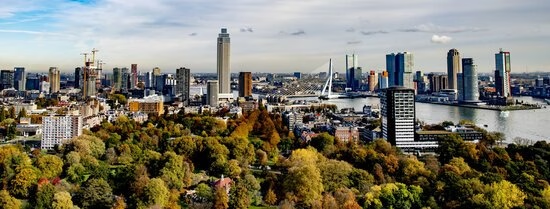
The Port of Rotterdam is still one of the largest industrial and energy areas in Europe. A great deal of work there still relies on fossil fuels, such as oil and gas. Can the port switch to clean and smart energy? And can it stay competitive with other countries while doing so? During the Opening Academic Year 2026/2027, Dr Yashar Ghiassi-Farrokhfal will share more on this. He is an Associate Professor at Rotterdam School of Management, Erasmus University (RSM). He also leads three initiatives in the field of energy: ECET, CESI and ECDA.
The theme of the Opening of the Academic Year is "Utopia? Building resilient societies". The central question is: how can academia, governments, businesses and civil society organisations work together to develop solutions for the future? For Ghiassi-Farrokhfal, the energy transition is a prime example of this.
The Port of Rotterdam as an example for Europe
The Port of Rotterdam is much more than a place where goods arrive and depart. The port area makes up just 0.3% of the Netherlands, yet it plays a crucial role in the energy supply of the Netherlands and Europe. That is precisely why, according to Ghiassi-Farrokhfal, the port has the potential to become one of Europe's leading living laboratories for the energy transition. 'The port of Rotterdam will remain Europe’s most important energy hub in 2050 as well. However, the source of the energy flowing through it will be fundamentally different.'

Today, everything still revolves largely around fossil fuels. But Ghiassi-Farrokhfal envisions a future built on green electricity, hydrogen, sustainable fuels and reusable raw materials. The port lies close to the wind farms in the North Sea. There is already extensive infrastructure in place, such as gas pipelines. And there are large industrial clusters that can work well together on electricity, hydrogen and residual heat.
Smarter choices through data and artificial intelligence
The shift to clean energy requires more than new wind farms or hydrogen pipelines, according to Ghiassi-Farrokhfal. The energy system is becoming increasingly complex, as solar and wind power, electric vehicles, heat pumps and batteries all need to work together more effectively. 'The future is uncertain. That is why we need to build systems that can adapt to different scenarios', explains Ghiassi-Farrokhfal.
Data and artificial intelligence play a major role here. So do 'digital twins': exact digital replicas of, for example, a factory, a building or even an entire city. This technology can help steer an energy system more intelligently. It can also help us make better decisions before billions of euros are spent on new infrastructure. His ambition is clear: working together to turn the Port of Rotterdam into one of the world's first truly smart ports. 'Instead of optimising each sector individually, we need to ensure that the entire energy system works together as a single entity.'
What will Rotterdammers notice?
The energy transition is not just happening within the port. Residents of Rotterdam will increasingly notice the changes in their daily lives too: at work, on the street, at home and even at the supermarket. One of the biggest benefits will be a cleaner and healthier living environment. As industry, shipping and heavy transport switch to clean energy, air pollution and CO2 emissions are expected to fall.

The labour market will also change significantly. Many new jobs will emerge in renewable energy, hydrogen, digital technology and artificial intelligence. Some traditional jobs will disappear or change. But demand for new skills is growing fast. 'The clean energy transition is likely to be one of the biggest sources of employment in the future,' says Ghiassi-Farrokhfal, who therefore also emphasises the importance of training and lifelong learning.
Citizens are also becoming more aware of, and more actively involved in, their own energy use. As homes, vehicles and appliances become increasingly connected, people get a clearer picture of how, when and why they use energy. 'Citizens are gaining more control over their energy data and can decide for themselves who they share it with,' says Ghiassi-Farrokhfal.
Our relationship with energy is changing too. In future, it will matter less how much energy we use per year, and more when we use it, particularly at busy times. Can we adjust our consumption accordingly? If we use more energy at times when plenty of green electricity is available, the electricity grid stays affordable and reliable. Flexibility is therefore set to become extremely valuable.

The most important choices are being made now
According to Ghiassi-Farrokhfal, the biggest challenge does not lie in 2050, but in the years ahead. Investment in electricity grids, hydrogen infrastructure and charting the course for the future will determine how the energy system functions for decades to come. 'The choices we make over the next ten years will shape the energy system for future generations.'
That is why, in his view, more is needed than technology alone. Education, digitalisation, new skills and collaboration are all essential to make the energy transition a success. 'The energy transition is not just a technical challenge. It is just as much an economic, social and administrative challenge.'
Building a resilient society together
No single organisation can solve this challenge alone. That is why Ghiassi-Farrokhfal sees an important role for our university: 'Erasmus University Rotterdam contributes by bringing together expertise in a range of fields. In this way, it helps governments, businesses and society to make better investment, operational and policy decisions during the energy transition.'
This multidisciplinary collaboration ties in seamlessly with the theme of the Opening Academic Year. After all, resilient societies do not emerge by themselves. They require knowledge, innovation and collaboration. Or, as Ghiassi-Farrokhfal puts it: 'The greatest challenge of the energy transition is no longer producing clean energy, it is making the right decisions to ensure it remains affordable and resilient, while becoming also clean and intelligent.'
- Researcher
- More information
Would you like to find out more about what the Port of Rotterdam might look like in 2050, according to Yashar Ghiassi-Farrokhfal? Come to the Opening Academic Year 2026/2027 on 31 August and find out more.
More science stories? Have a look at our online magazine Erasmus Extra.
- Related content


