As a child, Soheil Said watched the news about the credit crisis with his parents. He did not yet fully understand what was happening, but one thing fascinated him: how could the financial system have gone so badly off the rails, with such far-reaching consequences for society as a whole? Years later, he works as a Legal Counsel specialising in financial law – precisely the field where that question comes to the fore.
At a fund manager, Soheil advises on a wide range of financial law issues and oversees processes involving regulators such as the Netherlands Authority for the Financial Markets (AFM) and De Nederlandsche Bank (DNB). His work takes place at the intersection of financial supervision, fund management and governance, involving legislation and regulations such as the Financial Supervision Act (Wft), the AIFMD and the Wwft.
“What I love about my work is that you don’t just look at the law, but you also have to translate it into the day-to-day practice of a financial firm.”
Soheil actually knew even before he started his studies that he would be helping companies solve complex problems. Only the form this would take was still unclear. Looking back, he was close to the mark, with one important insight added: solving problems as a lawyer often does not mean having to fix something after the event, but rather trying to prevent the problem from arising in the first place.
“You’re not just concerned with the question ‘What are we allowed to do?’, but also with ‘How can we make this possible in a legally sound way?’”
His interest in law developed at an early age. From a young age, he was curious about how society is organised and why certain rules exist; he followed politics, read crime novels and watched films in which legal issues played a part. His specific interest in financial law emerged towards the end of his Master’s in Private Law, when he was studying ESG and corporate social responsibility and gained experience with sustainability legislation at a large consultancy firm. It was there that he realised he wanted to delve deeper into regulations that directly affect the way in which companies and financial markets operate.
There is one skill from his student days that he still uses every day: finding, assessing and combining legal sources. He is regularly asked questions to which he does not know the answer straight away, and in such cases it is important to quickly work out where to find that answer and to link together various sources, ranging from legislation and regulations to case law and policy documents.
“What perhaps felt at the time as a purely academic skill has, in practice, turned out to be one of the most useful skills I learnt during my studies.”
According to Soheil, what outsiders tend to underestimate is how much work lies behind a seemingly simple legal answer. When a lawyer has an answer ready straight away, it sometimes seems as though that knowledge comes naturally. In reality, this is preceded by years of study, experience and constantly keeping up to date with developments. This is certainly true in financial law, which is evolving at breakneck speed and is largely determined by European regulations. You never stop learning, and that is precisely what makes the profession so interesting to him.
Soheil has gained more from his time at university than just legal knowledge. The friendships he forged back then have lasted for years. What he does sometimes miss, however, is the feeling of being in the same boat together – the sense of camaraderie amongst a group of students all working towards the same goal at the same time, whether that was an exam or a dissertation.
“I do sometimes miss that combination of excitement, ambition and camaraderie.”
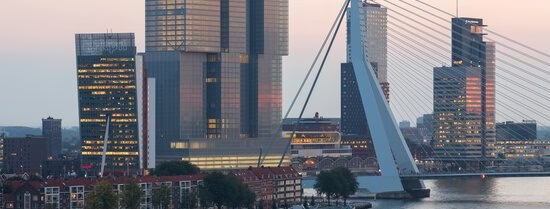
Looking back, he sees his decision to choose Rotterdam as a fortunate one. The practical approach to teaching, with guest lecturers from the legal profession and visits to law firms, gave him an insight into the various directions a law degree can take whilst he was still a student. Moreover, he has noticed that lawyers from Rotterdam have a good reputation in the business world. As far as he is concerned, that down-to-earth, analytical and results-oriented mindset fits in well with legal practice.
“Looking back now, I’m particularly glad that I chose Rotterdam at the time.”