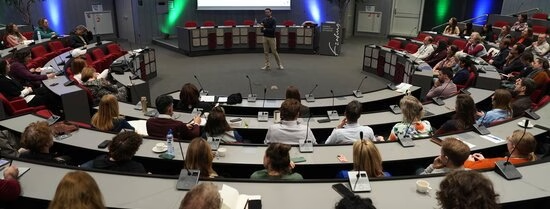
On Thursday 26 March, around 130 teachers, support staff and students gathered for another edition of EdUconnect, the annual conference on educational innovation, organised by the Community for Learning & Innovation (CLI). The theme of this year? Alternative Assessment!
As the educational landscape continues to evolve and technological advancements such as generative AI (GenAI) continue to influence education, educators are being challenged but also given the perfect opportunity to fundamentally rethink traditional assessment methods. Through interactive discussions and workshops, participants were immersed in the world of alternative assessment!

Opening & Keynote
In the morning of 26 March 2026, participants, from within and outside the Erasmus University Rotterdam, gathered in the Forumzaal (Van der Goot building) to kick-off EdUconnect 2026. The programme was opened with a seemingly straightforward question: “What is so alternative about alternative assessment? What makes it alternative?” Yet, responses showed different perspectives and focal points. All in all, a great start to the morning: rich discussion and plenty of room for deeper exploration!
The programme continued with a keynote speech by dr. Rob Kickert, assistant professor at the Educational Master Primary Education (EMPO). In about 30 minutes, Rob explored the fundamentals of assessment, the relation between good education and assessment, and proposed alternative quality criteria, such as soft emancipation and catalytic validity, that characterize alternative assessment, rooted in participatory action research. His insights gave participants room to reflect on their own assessment practices and the keynote was later named one of the highlights of this EdUconnect edition.


Interactive Discussion
The plenary session of EdUconnect closed with an interactive discussion, centred around three cases bringing forward both student perspectives and a teacher perspective on (alternative) assessment and its implications. The cases touched upon different aspects and provided substantial room for dicussion: how teachers can and/or should support students navigating non-traditional assessment methods, whether the tension between assessment quality and meaningful feedback is an inherent contradiction or something to be reconciled, and what role teachers can and/or should have in mitigating the impact of assessment on student wellbeing, including stress and sleep deprivation. During the discussion, divergent perspectives emerged on the function of assessment and teachers, with ample consideration of the practical and time-constraints placed on academic staff. Whilst the discussion was far from exhaustive, it made clear that the topic is highly timely and worthy of continued academic debate.


Workshops and Panel Discussions
The interactive discussion was followed by two rounds of workshops/panel sessions, in which colleagues and students shared their knowledge and experiences:
- Workshop | Automated Grading with AI: How to Save Time and Improve Your Feedback by dr. Nick Koning (ESE).
- Workshop | A toolkit for Authentic Assessment of Skills by dr. Dimitrios Vlachopoulos (RSM).
- Workshop | Supporting Skills Trajectories through Feedback Literacy: A Programme Perspective by mr.dr. Hanna Weijers (ESL).
- Workshop | Interactive Feedback and Assessment with the FeedbackFruits Tool by Suzie Lednor (FeedbackFruits)
- Panel 1 | Alternative Graduation Projects: Multiple Perspectives on Societal Impact, led by Marit Nieuwenhuys and William Pitz (Risbo), with panel members Cees Zweistra (ESL), Adham Aly (ESSB), Katharina Bauer (ESPhil) and former student Famke Zwinkels (ESSB).
- Panel 2 | Navigating AI in Assessment: Student and Teacher Perspectives, led by Jonathan Flores Minuesa (CLI), with panel members Aki Negate (ESSB), Margreet Luth-Morgan (ESL) and student Kira van de Berg (ESPhil).
During the workshops, participants gained practical tools and tips to support the integration of alternative assessment methods. In the panel discussions, participants listened to and engaged in lively discussion on alternative graduation projects and generative AI. During the first panel, participants steered the conversation towards practical challenges of developing and implementing alternative graduation projects. The second panel centered around more fundamental questions, touching on, for instance, differing perceptions of assessment and (deeper) assumptions about student motivation and academic integrity. Both the workshops and panels emphasized interactivity and inspiration, which was highly valued by participants.


Final Thoughts and Save the Date
EdUconnect 2026 brought together teachers, support staff and students from both within and outside of the Erasmus University Rotterdam, all connected or interested in the theme 'Alternative Assessment'; and this is exactly what participants seemed to appreciate: an environment where they could connect, interact and be inspired by like-minded individuals. Overall, participants gave the progamme a 8,4/10!
Already looking forward to the next edition of EdUconnect? Then, put 8 April 2027 (9:00-13:30) in your calendar and we look forward to seeing you then! While the theme remains a mystery for now, it promises to be another inspiring session where educational innovation takes center stage.
Interested in assessment? Join the Community of Practice (CoP) on Assessment!
On 21 May, the first university-wide Community of Practice on Assessment will take place! This community shares a passion around the relation between assessment and good education. The CoP aims to raise critical questions about the way we currently assess students and to work together to find ways to improve our assessment practices. Also increasing pressure on assessment because of developments around generative AI and a decline in international students, will be discussed. The first session will kick-off by considering the question: “What do you think are the goals of education and how do your assessments align with those goals?”. In the second hour, we will discuss the advisory and instructional role that the CoP can play. The CoP is organised by the CLI, in collaboration with dr. Rob Kickert.
For more information or to sign up, reach out to cli@eur.nl.
- More information
Photography
During EdUconnect, photo's were taken that are intented solely for communication use by the Communication for Learning & Innovation (CLI). At the CLI we work with an opt-out system. Have you decided, at a later moment, that you do not wish to be visible in EdUconnect photo's, please sent an e-mail to cli@eur.nl and we will adjust and/or select different photo's.Educational support
If you were unable to attend the event but wish to gain more insights on alternative assessment and its implementation in (your) courses, there are several opportunities available. If you are looking to actively shape the academic debate, join the Community of Practice on Assessment by sending an email to cli@eur.nl. If you are looking for more support in innovating your education, request an innovation project. Or if you are more interested in researching educational practices, apply for a CLI Fellowship. For further questions or to explore your options, reach out to the CLI via cli@eur.nl.
